
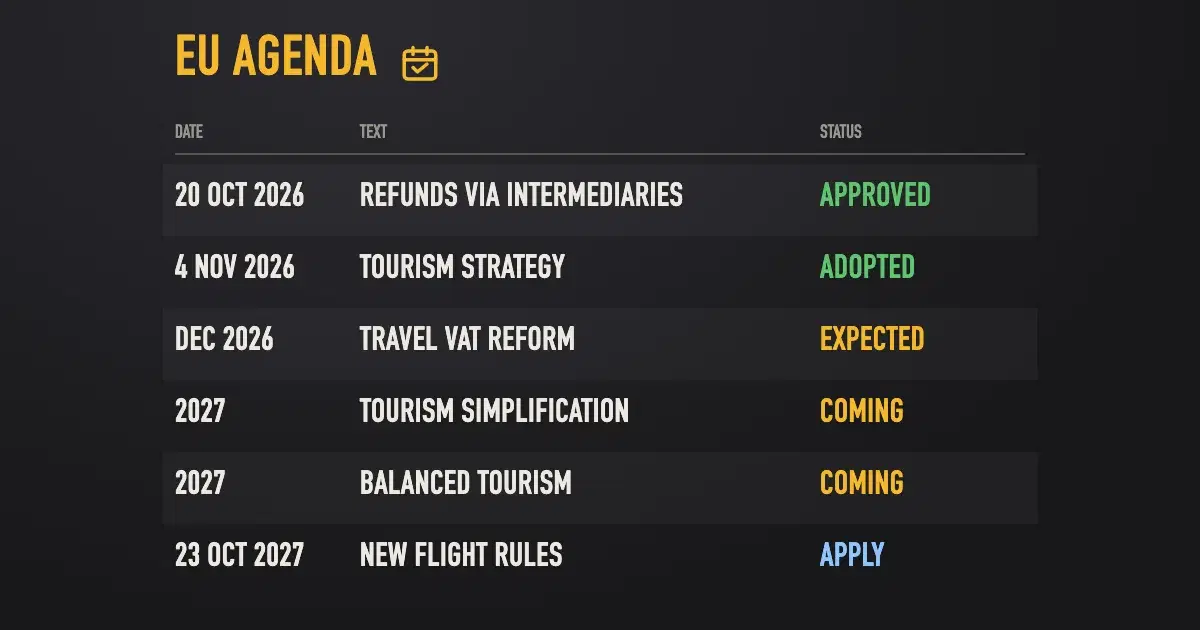
On 4 November the Commission adopted its tourism strategy. By December it promises the sector's VAT reform.
The EU Sustainable Tourism Strategy (COM(2026) 777), adopted by the Commission on 4 November, sets out ten areas of action for the coming years. Almost all of them are plans, studies and recommendations: tourism remains a competence of the Member States. But one line has a date close at hand and directly concerns anyone who sells travel: before the end of 2026 the Commission will present a proposal to modernise the VAT rules for travel and tourism.
In the same weeks a second piece of work came to a close. On 20 October the European Parliament approved, with 652 votes in favour, two against and eight abstentions, the regulation on the enforcement of passenger rights, the one that requires intermediaries to refund their own fee too when a flight is cancelled. The final text, dated 4 November, confirms the rules we described in October and puts in black and white an exception that matters: they do not apply to tickets sold as part of a package.
Meanwhile, things have moved on AI agents. On 11 November United Airlines began preventing unauthorised AI assistants from booking on its website, while the EU strategy proposes giving AI agents a digital identity document.
Three different stories, one direction: Europe is rewriting who answers for what when a trip is sold.
The strategy, read by those who sell travel
The strategy starts from the sector's figures: in 2025 the EU welcomed almost 600 million international tourists, around 40% of the world's arrivals, and tourism directly accounts for 4.1% of European value added. There are around five million businesses: 99% are SMEs, 96% micro-enterprises. Here are the parts that affect agencies, tour operators and DMCs.
Simplification. By 2027 an EU Simplification Initiative for tourism will be launched, to gather real data on businesses' administrative burdens. The text says it clearly: obstacles can come from EU rules, but also from how Member States apply them and from national rules added on top of what the directives require.
Packages. The strategy recalls that the package travel directive revised in 2026, Directive (EU) 2026/1024 of 29 April, is meant to reduce the burden on operators and clarify organisers' obligations: the Commission estimates at least €181.4 million a year in lower administrative costs across the EU.
Platforms. Online booking platforms, the Commission writes, must operate with transparent and fair practices, and enforcement of the Digital Markets Act and the Digital Services Act serves to protect the independence of tourism businesses. The text also notes that hotel groups, carriers, large tour operators and platforms control capital, data and technology, and encourages collaboration between them and SMEs.
Destinations and seasons. 42% of nights spent in Europe are concentrated in the three busiest months. By 2027 there will be a proposal for a Council Recommendation on Balanced Tourism Management and an "EU Toolbox for Balanced Tourism" for destinations, which will also cover measures on short-term rentals, as well as a European dialogue on cruises.
Transport. By 2027, the revision of the Air Services Regulation and a proposal to hire a car in one country and use it across the border at lower cost; by 2028, solutions to make local transport tickets compatible across the EU. There is also a small, useful change for anyone who organises coach tours: an initiative to make the rules on vehicle access to city centres accessible.
Crises and data. By 2027, an EU Tourism Crisis Coordination Network and an EU Tourism Observatory.
ECTAA, the European association of travel agents and tour operators, welcomed the strategy on 5 November and saw in the VAT reform an opportunity to correct market distortions and make conditions fairer between businesses.
VAT on the margin: the proposal is due by December
For decades, agencies and tour operators that sell travel in their own name have applied the special scheme for travel agents (TOMS), Articles 306-310 of the VAT Directive: tax is paid on the margin rather than on the full price, in the country where the agency is established. It is the same scheme we explained in May, and the Commission has long considered it to be applied unevenly across Member States.
Here is what is known about the reform so far:
- the strategy says the proposal will bring the rules in line with how travel has evolved, with digitalisation and with the global context, to make European operators more competitive and conditions in the internal market more equal, while simplifying compliance for passenger transport providers, especially SMEs;
- the Commission's public consultation, open from 28 July to 16 October 2025, covered both the special scheme for travel agents and VAT on passenger transport;
- for ETOA, the European tourism association, the main issue is where the margin is taxed, with the real risk that the EU will also want to tax the margin on sales by non-EU operators;
- VAT rules can only be changed by unanimity of the 27 Member States: years can pass between the proposal and its application.
The text of the proposal has not been published yet, and any assumption about its content remains an assumption for now. But two things can already be said. First: for those who apply the margin scheme, knowing the margin trip by trip, with the right costs attributed to each booking, will remain the starting point, whatever the reform. Second: those who sell a lot abroad or to other businesses, such as a DMC working for foreign tour operators, will need to read carefully where the proposal places the taxation of the margin.
Flight refunds: the final text, with the package left out
The regulation on the enforcement of passenger rights will apply from 23 October 2027, the same day as Regulation (EU) 2026/2202 on air passenger rights. After Parliament's vote the text goes to the Council for formal adoption, and then to the Official Journal. The text of 4 November adds to Regulation 261/2004 two articles written for those who sell tickets on behalf of others.
Before booking (Article 8b). The intermediary must tell the passenger clearly whether the airline agrees to refund through the intermediary and how the refund will work. It must state the intermediation fees, any administrative, service or cancellation charges, and the passenger's right to get the intermediation fee back in full as well. A refund made through the intermediary is free of charge for the passenger.
Refund deadlines. If the agency paid for the ticket with its own funds, the airline refunds the agency within seven days of the passenger's choice, and the agency refunds the passenger, ticket and intermediation fee, within a further seven days, using the same means of payment used for the booking. If after 14 days the airline has no confirmation that the passenger has been paid, it contacts the passenger and refunds them directly.
The micro-enterprise exception. An agency that is an autonomous micro-enterprise, as defined under EU law, may decide not to refund a specified part of its intermediation fee, provided it told the passenger at the start of the booking, in a clear, unambiguous and prominent manner. So not at the bottom of the terms.
Business travel. When the agency charges a business a flat or volume-based fee for all the tickets over a period, the text considers that there is no intermediation fee to refund on the individual tickets.
Identifying yourself to the airline (Article 14a). Before booking, the intermediary must tell the airline that it is booking as an intermediary, and pass on the passenger's contact details and the booking details. This is the end of screen-scraping, booking on the airline's website without identifying yourself.
The package stays out. Both articles end with the same sentence: they do not apply to tickets booked as part of a package as defined in Article 3, point (2), of Directive (EU) 2015/2302. In a package the traveller already has a single party responsible, the organiser, with its own rules on refunds and protection.
There is no shortage of reasons to be clear about these rules. Volotea, which filed for pre-insolvency protection in September, will go from 44 to 30 aircraft according to Air Journal, and has moved the agreement with its creditors, planned for December, to late January or early February 2027; some French distributors have suspended sales, and its director for France has apologised to them. It is still flying, but this is exactly the case in which someone who bought a flight on its own remains a creditor of an airline in restructuring.
AI agents: airlines close the door, Brussels asks for ID
On 11 November United Airlines changed its booking and distribution rules: as reported by PYMNTS, unauthorised AI assistants can still search for flights and fares, but cannot book, change a ticket or check in, not even through agencies and aggregators. The airline says that bookings made by automated assistants are very few today.
The day before, OpenAI had acquired Odessia, a service that planned and booked flights, hotels and experiences in a single conversation, opened to the public on 14 October and closed straight after the acquisition. And Booking Holdings says that traffic coming from AI chatbots remains well below 1% of the nights booked on Booking.com. AI agents that book on their own are, for now, more announced than used.
The EU strategy looks at the same problem from another angle. The EU Digital Identity Wallets, the Commission writes, will provide a secure framework for identifying and authorising AI agents in travel: the traveller authorises their agent, and a business that uses AI agents has them recognised through the European Business Wallets, which state which company each agent works for and what it can do. A pilot project with public and private organisations is planned. The idea is the same as the ban on screen-scraping: whoever books must say who they are, and on whose behalf.
For an agency this is good news. AI that prepares the quote, reads a rate sheet or writes to the supplier works inside the agency, which remains the identified and responsible seller. And that is exactly what the rules are asking for.
What to do now
Tour operators and DMCs: get ready to read the VAT proposal. When it comes out, in December, the question will be how much your margin changes. Arriving with the margin of every trip already calculated, and knowing what share of your sales goes to businesses or to clients in other countries, will show you straight away where the proposal affects you. National and European associations will follow the negotiations: now is the time to make your cases heard.
Those selling flights: prepare the opening sentence. If you are a micro-enterprise and want to keep part of your fee in case of cancellation, the sentence must be given at the start of the booking, not in the terms. For everyone: agree with the consolidators and airlines you work with how refunds will be handled, and get ready to identify yourselves as intermediaries and pass on passengers' contact details.
When you can, sell the package. The new rules for intermediaries do not apply to tickets within a package, where the directive already applies: an organiser who answers for everything, insolvency protection, a price that does not change by surprise. For a client buying a flight and a hotel it is the simplest choice to explain.
Keep a note of the burdens. In 2027 the simplification initiative will gather concrete examples of red tape, including national rules that go beyond the EU directives. Every form you fill in twice and every obligation that is heavier in your country than elsewhere is an example to take to your association.
Use AI on the right side. Booking with tools that do not identify themselves to the airline is becoming ever riskier. Using AI to work faster, with your suppliers and in your own name, is the path the rules are laying out.
The rules for those who sell travel
Taken together, this autumn's texts describe a Europe that wants to know who sells what: the intermediary that identifies itself to the airline, the AI agent with its identity document, the margin taxed in a precise place. For agencies, tour operators and DMCs it means more work, but also recognition: the rules start from the idea that behind a trip there is someone who answers for it. The package, once again, is where that responsibility is already written down.
Ready to modernise your agency?
itinovo CRM handles margin scheme VAT, quotes, invoicing and suppliers, so you can focus on your clients.
Start free trial