
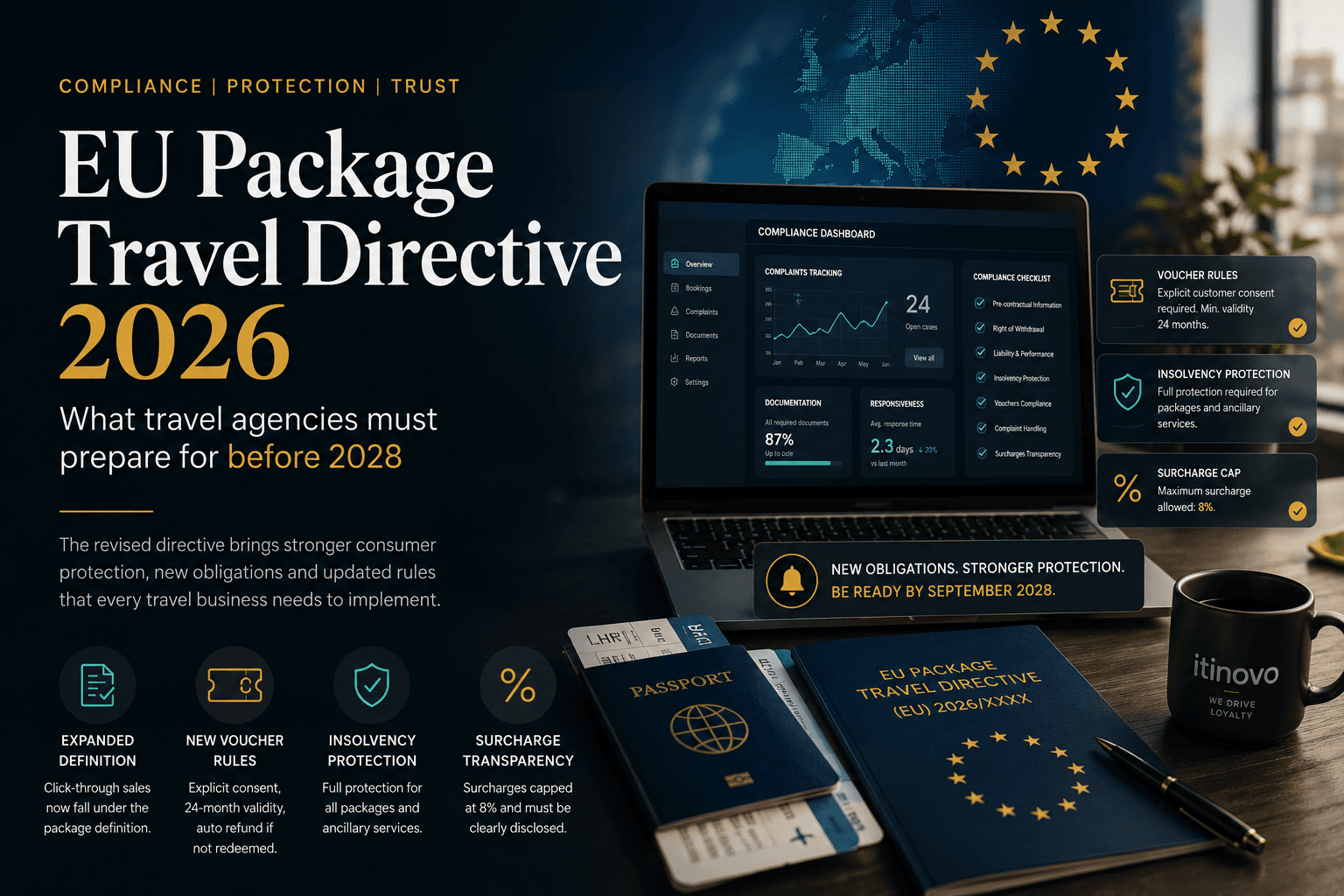
The Revised EU Package Travel Directive 2026: What Agencies Must Know
The European Parliament approved a major overhaul of the Package Travel Directive in March 2026. From expanded package definitions to new refund timelines, here is everything travel agencies need to prepare for before September 2028.
Why the directive has been revised
Directive (EU) 2015/2302 on package travel has applied since 1 July 2018 and, on the whole, it has worked well. The pandemic, however, showed where it was weak: unclear information for travellers, slow refunds, vouchers imposed differently from one country to the next, no rules on the refunds suppliers owe to organisers, and doubt over whether refunds and vouchers were covered by insolvency protection.
The answer is Directive (EU) 2026/1024. The European Parliament adopted its position on 12 March 2026 and the Council on 30 March; the directive is dated 29 April 2026 and was published in the Official Journal on 8 May. It does not replace the 2015 directive: it amends it. Member States must transpose it by 29 September 2028 and apply the new rules from 29 March 2029.
For travel agencies and tour operators, six things change: what counts as a package, the information to give, cancellations and refunds, vouchers, insolvency protection and complaint handling. Here they are one by one, with the articles they come from.
What becomes a package
Linked online bookings. Since 2015 a combination booked through linked online booking processes has been a package when the first trader passed the traveller's name, payment details and email address to the second and the second contract was concluded within 24 hours. That condition on the data proved too narrow. From 2029 it is enough that personal data identifying the traveller as a contracting party are passed on (Article 3, point 2, letter b, v).
The 25% threshold moves into the article. Transport, accommodation or car rental combined with other tourist services, such as an excursion or a concert ticket, is not a package if those other services account for less than 25% of the value of the combination and are neither advertised as nor otherwise an essential feature of the trip, or if they are selected and purchased after the first service has started. In 2015 the article spoke of a "significant proportion" of the value and the 25% figure sat in the recitals; now the number is in the definition.
Linked travel arrangements disappear. The intermediate category of linked travel arrangements, with its own information form and its own protection, is abolished together with Annex II.
The invitation to add a service. In its place comes a new obligation (Article 5a). When a booking is not a package and the trader invites the traveller to add another type of travel service for the same trip, the trader must say clearly and prominently that, if the traveller pays for the additional service after the first one, the two will not form a package and the traveller will not have package rights. If that notice is missing and the traveller pays for the additional service at the same point of sale within 24 hours of the first payment, the services form a package and the trader becomes its organiser.
Calling yourself an intermediary is not enough. Article 23 makes it explicit: declaring that you act only as an intermediary, or that a package is not a package, does not release the organiser from the obligations of the directive.
For an agency the practical consequence is immediate: every time another service, such as a rental car or a transfer, is offered on top of a hotel-only or flight-only booking, the right notice is needed at the right moment, otherwise you risk selling a package without knowing it.
The information to give, and the form to attach
Pre-contractual information gets richer (Article 5). You must say whether the services are accessible to persons with reduced mobility, whatever the cause and even if temporary, and give more precise information on request. Payments with loyalty points or rewards count too, as do the approximate times for obtaining visas and the traveller's right to terminate at any time against appropriate fees, or free of charge in case of unavoidable and extraordinary circumstances. The contact details of organiser and retailer must allow travellers to reach them quickly.
The standard information form in Annex I, rewritten, must be attached to the contract and provided on a durable medium when the contract is concluded, and the contract must refer to it explicitly (Article 7, paragraph 2a). The contract must also state that the organiser is responsible for the performance of all services, for refunds and for assistance, that the traveller can contact the organiser through the retailer as well, and how complaints are made: in which languages, at which address, and with which alternative dispute resolution body.
Cancellations and refunds
Clear termination fees. The traveller can always terminate before departure by paying appropriate and justifiable termination fees, if the contract provides for them (Article 12). The contract can set standard fees, as fixed amounts or percentages depending on how close to departure the termination happens, or state that the fees equal the price minus the savings and income from reselling the services. If the contract provides for fees without saying how they are calculated, the second criterion applies. On request, the organiser must justify the fees charged.
Unavoidable and extraordinary circumstances. Termination without fees is possible when the circumstances can reasonably be expected to have a substantial effect on the package, whether they occur at the place of departure, at the destination or in its immediate vicinity, or affect the journey to the destination.
Refunds within 14 days, without a request. Refunds must be made within 14 days of the termination of the contract, without the traveller having to ask for them. If within those 14 days the parties agree on a substitute package of equivalent or higher quality, no refund is due; if the substitute costs less, the difference must be paid back.
Suppliers refund on a deadline too. This is the change organisers have waited for: a supplier that cancels or does not provide a service included in a package must refund the organiser what it received within seven days (Article 22). During the pandemic many organisers had to refund their customers while still waiting for money from airlines and hotels.
Vouchers: common rules across the Union
Instead of a refund, the organiser may offer a voucher, but the choice stays with the traveller (Article 12a). Before the traveller expressly accepts it, the organiser must tell them on a durable medium that they are entitled to a refund within 14 days and are not obliged to accept the voucher; what the voucher is worth and how much the refund amounts to, which remains covered by insolvency protection; that the voucher can be used in parts, for any service of the organiser, but that a single service booked with it is not protected by the directive; how long it is valid; that it can be transferred once, free of charge; and that any unused part will be refunded within 14 days of expiry, without having to ask.
A voucher is valid for at most 12 months from acceptance, extendable once by up to 12 more months if both parties expressly agree on a durable medium. While it is valid the right to a refund is suspended; the suspension ends at expiry, if the parties agree on a refund, or if the organiser becomes insolvent. Voucher holders must not be treated less favourably than other customers when booking.
Insolvency protection
Article 17 is rewritten. The organiser's security covers all payments made by travellers, including when the package is not performed or the traveller is entitled to a refund; if they received a voucher, it covers the refund they were entitled to. If the package includes the return journey, it also covers repatriation and, where necessary, accommodation before repatriation.
The security must be effective and sufficient at all times: it must take into account the time between payments and the end of the trips, the cost of repatriation, the fact that an insolvency may happen precisely when the organiser holds the most customer money, and changes in sales volume. Member States supervise the protection of organisers established on their territory.
Travellers must be refunded within six months of submitting the necessary documents, nine in exceptional circumstances, such as an exceptionally high number of claims or an insolvency affecting travellers from several countries. They are protected wherever they live, depart from or bought the package, and organisers from third countries that sell in the Union must provide security under the law of the country where they sell. Each Member State publishes an online register of protected organisers and may also require retailers to have their own protection. Between Member States, central contact points must give a first reply within 15 working days.
Complaints on a deadline
The organiser must be easy to reach and respond efficiently to travellers' requests, above all when they are in difficulty or when something goes wrong during the trip (Article 16a). For other complaints, it must acknowledge receipt on a durable medium within seven days and give a reasoned reply, also on a durable medium, within 60 days. Member States may set shorter periods. If it does not fully accept the complaint, it must tell the traveller which alternative dispute resolution bodies they can turn to.
An email left in a shared inbox is no longer enough: you need a date of receipt, an acknowledgement and a reply that can be traced.
What does not change: price increases and liability
Some rules stay as they were in 2015, and they are worth recalling because they are often mistaken for new ones. The package price can only rise if the contract expressly provides for it and only because of changes in specific costs, such as fuel, taxes or exchange rates, notified at the latest 20 days before departure. Above 8% of the price, the traveller can terminate with a full refund, and if costs fall they are entitled to a reduction. The organiser remains responsible for the performance of all services in the package, even when a supplier performs them.
How to prepare
The timetable is clear: national laws by 29 September 2028, new rules in force from 29 March 2029. Each country may shorten some deadlines, such as those for complaints and for refunds from the insolvency protection, so it pays to follow the transposition in your own country. In the meantime, here is where to start:
Sales paths. Map every case in which another service is offered on top of a single one, on the website, by phone or at the counter, and prepare the Article 5a notice. Check the 25% threshold on combinations with excursions and events.
Documents. Update the information form with the new Annex I and attach it to the contract, add accessibility, visas and complaints to the pre-contractual information, and write a clear schedule of termination fees.
Refunds and vouchers. Get organised to refund within 14 days without a request, and prepare a compliant voucher: information on a durable medium, the 12-month expiry kept under control, transfers recorded, automatic refund of the balance.
Suppliers. Review contracts with hotels, airlines and DMCs in light of the seven-day refund they will owe the organiser.
Insolvency protection. Ask your fund or insurer whether the cover will include refunds and vouchers and whether it will be sufficient in the months when you collect the most.
Complaints. A dedicated channel, acknowledgement within seven days, a reasoned reply within 60, and the alternative dispute resolution body named.
The revision does not overturn the trade: it makes it more traceable. Agencies that reach 2029 with orderly processes, updated documents and a record of every communication will not only carry less risk: they will be able to explain to their customers, rules in hand, why booking a package with them is safer than putting one together alone.
Ready to modernise your agency?
itinovo CRM handles margin scheme VAT, quotes, invoicing and suppliers, so you can focus on your clients.
Start free trial