
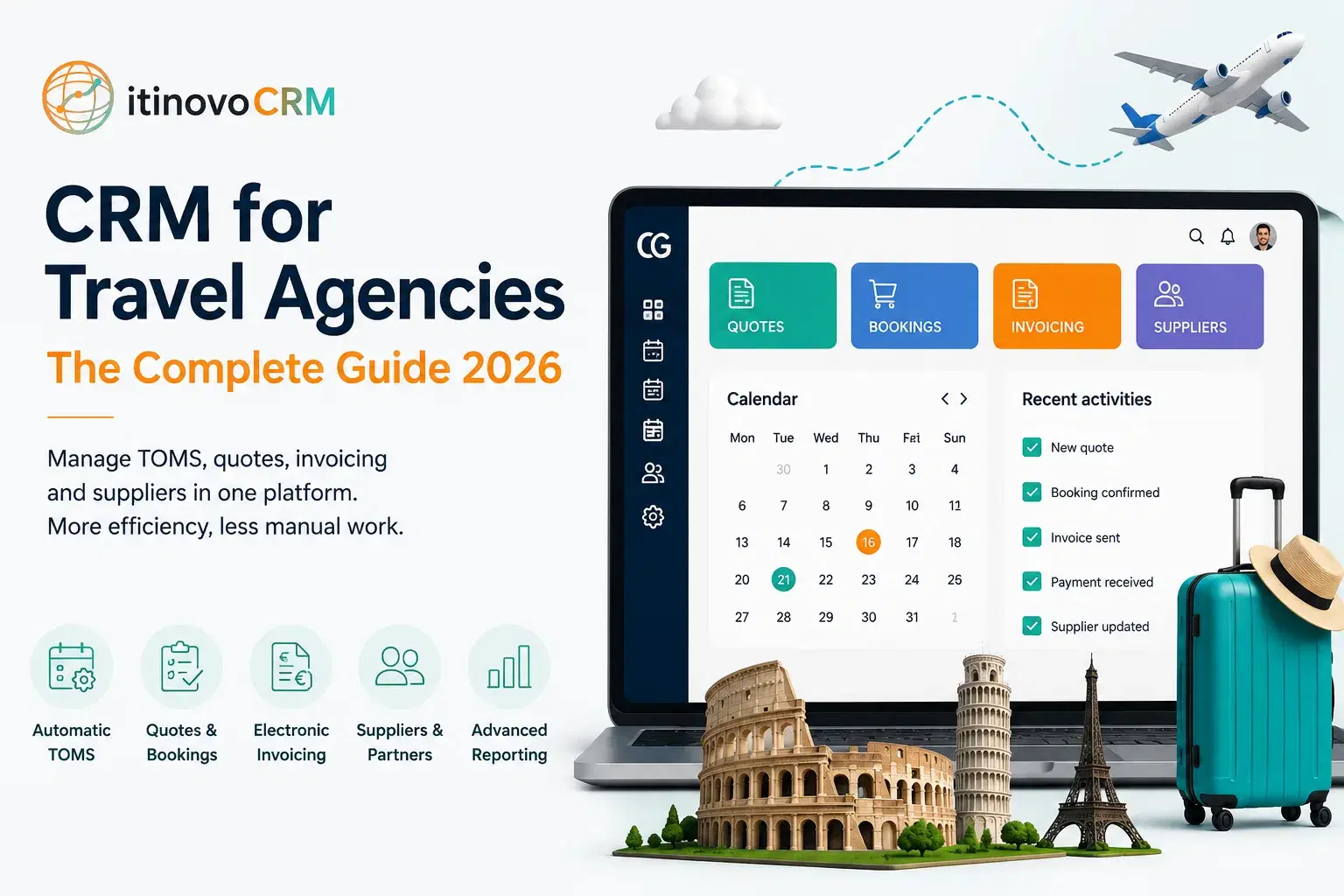
CRM for Travel Agencies: The Complete 2026 Guide
Why generic CRMs fail travel agencies, what to look for in a vertical solution, and how the right tool can cut admin time by 60%.
Why generic CRMs don't work for travel
Travel agencies have unique workflows that Salesforce, HubSpot, or Monday.com simply cannot handle out of the box. You need TOMS VAT on margins, multi-day itinerary quotes with per-service costing, supplier confirmation tracking, and EU Package Travel Directive compliance. Customising a generic CRM to do all this costs more than a purpose-built solution.
The fundamental problem is that generic CRMs are designed around a sales pipeline with a single product or service per deal. Travel agencies sell complex, multi-component packages where each service has its own supplier, cost structure, confirmation status, and cancellation policy. A single booking might involve a hotel in Rome, a transfer from Fiumicino, a guided tour of the Colosseum, and a cooking class in Trastevere: each from a different supplier with different payment terms. No amount of Salesforce customisation makes this natural.
Beyond the structural mismatch, there are regulatory requirements that generic tools simply ignore. The Tour Operators Margin Scheme (TOMS) requires VAT calculation on the margin between selling price and supplier costs: not on the full invoice amount. The EU Package Travel Directive mandates specific contract clauses, cancellation policies, and insolvency protection documentation. E-invoicing formats vary by country (FatturaPA in Italy, Factur-X in France, ZUGFeRD in Germany, Verifactu in Spain). A generic CRM knows nothing about any of this.
What a travel-specific CRM should include
A proper travel CRM covers the entire booking lifecycle: lead capture, multi-version quotes with real-time margin calculation, supplier rate management, branded PDF documents (roadbook, voucher, contract), invoicing with TOMS, and post-trip feedback collection. Integration with marketplaces and tour operator catalogs is a bonus.
The quote builder is the heart of any travel CRM. It should support day-by-day itinerary construction with multiple services per day, each linked to a supplier and a specific rate. As you build the quote, the system should calculate your margin in real-time, showing you exactly how much you earn on each service and on the package as a whole. Markup should be configurable per service (percentage or fixed amount), and the total should update instantly as you add or modify components.
Supplier management is equally critical. Your CRM should maintain a centralised database of all suppliers with their seasonal rates, contact details, payment terms, and performance history. When you add a hotel to a quote, the system should automatically suggest the best available rate for the travel dates: no manual lookup in spreadsheets required. Commission tracking for tour operator products should be automatic, flagging unpaid commissions after the agreed payment period.
Document generation separates professional agencies from amateur operations. Your CRM should produce branded PDFs: quotes with your logo and colour scheme, detailed roadbooks with day-by-day descriptions and photos, individual vouchers for each service, and legally compliant contracts with EU Directive clauses. These documents should be generated with one click, not assembled manually in Word.
The cost of manual processes
Agencies using spreadsheets or generic tools spend an average of 3-4 hours per booking on administrative tasks: calculating margins, formatting quotes, tracking supplier confirmations, and reconciling payments. A vertical CRM automates 80% of this work.
Consider the typical workflow without a dedicated system. You receive a lead, open Excel to check supplier rates (hoping the file is up to date), manually calculate costs and margins, format a quote in Word or PowerPoint, email it to the client, wait for a response, manually follow up after a week, receive changes, rebuild the quote from scratch, send again, get acceptance, manually email each supplier for confirmation, track responses in your inbox, create an invoice in your accounting software, applies the margin scheme separately, and finally reconcile payments weeks later. Each step is a potential point of failure.
With a vertical CRM, the same workflow becomes: receive lead (auto-captured from website or marketplace), build quote with auto-matched rates and real-time margins, send via client portal with one click, receive automatic notification when client views it, auto-follow-up after configurable delay, client accepts online, system auto-generates supplier confirmation emails, track confirmations in a dashboard, generate TOMS-compliant invoice with one click, and reconcile payments automatically. The time savings compound with every booking.
Key features to evaluate
When choosing a travel CRM, prioritise: automatic TOMS calculation, quote versioning with client portal, supplier catalog with seasonal rates, e-invoicing support for your country, and a mobile-friendly interface. AI capabilities (like natural language operations) are becoming table stakes in 2026.
Quote versioning is often overlooked but critically important. Clients rarely accept the first version of a quote. They want changes: different hotels, shorter duration, added excursions. Without versioning, you lose track of what was proposed, what was changed, and what was finally agreed. A good CRM maintains v1, v2, v3 with full comparison between versions, so you can always see exactly what changed and when.
The client portal transforms the quote acceptance process. Instead of emailing PDFs back and forth, your client receives a link to a branded portal where they can view the quote, ask questions, request changes, accept, and even pay online. This reduces friction dramatically: no more lost emails, no more "I'll get back to you" that never materialises. The portal also provides a professional image that distinguishes you from agencies still operating via email attachments.
E-invoicing compliance is non-negotiable in 2026. Italy has required FatturaPA since 2019. France mandates Factur-X for B2B from September 2026. Germany and Spain are following. If your CRM cannot generate the correct electronic invoice format for your country, you will need a separate tool, adding complexity and cost. Look for a system that handles this natively.
How itinovo CRM addresses these needs
itinovo CRM was built exclusively for European travel agencies. It includes automatic TOMS on every quote, 3 e-invoicing formats (FatturaPA, Factur-X, ZUGFeRD), a supplier catalog with tour operator products, branded travel documents, and an AI Agent that can create invoices and send quotes through simple chat commands.
The platform supports the full booking lifecycle from lead capture to post-trip feedback. The pipeline tracks leads through travel-specific stages (new, quoting, pending, confirmed, travelling, completed), with automatic transitions as the booking progresses. The quote builder supports three presentation modes (detailed day-by-day, grouped by category, or lump-sum package) adapting to different client expectations and trip types.
For agencies working with tour operators, the supplier catalog supports both direct suppliers (net rates with markup) and tour operator products (commissionable rates). Rate matching is automatic based on travel dates, occupancy, and meal plan. Commission tracking records expected earnings at booking time and flags unpaid commissions for reconciliation.
The AI Agent represents the next evolution in CRM interaction. Instead of navigating menus and filling forms, operators can simply type "create an invoice for the Rossi booking and send it", and the system executes the entire workflow: creates the invoice, applies the margin scheme, generates the PDF, and sends it via email. This is not a chatbot that answers questions; it is an operational agent that performs real actions on your data, with confirmation prompts for write operations and full audit logging.
Ready to modernise your agency?
itinovo CRM handles margin scheme VAT, quotes, invoicing and suppliers, so you can focus on your clients.
Start free trial