
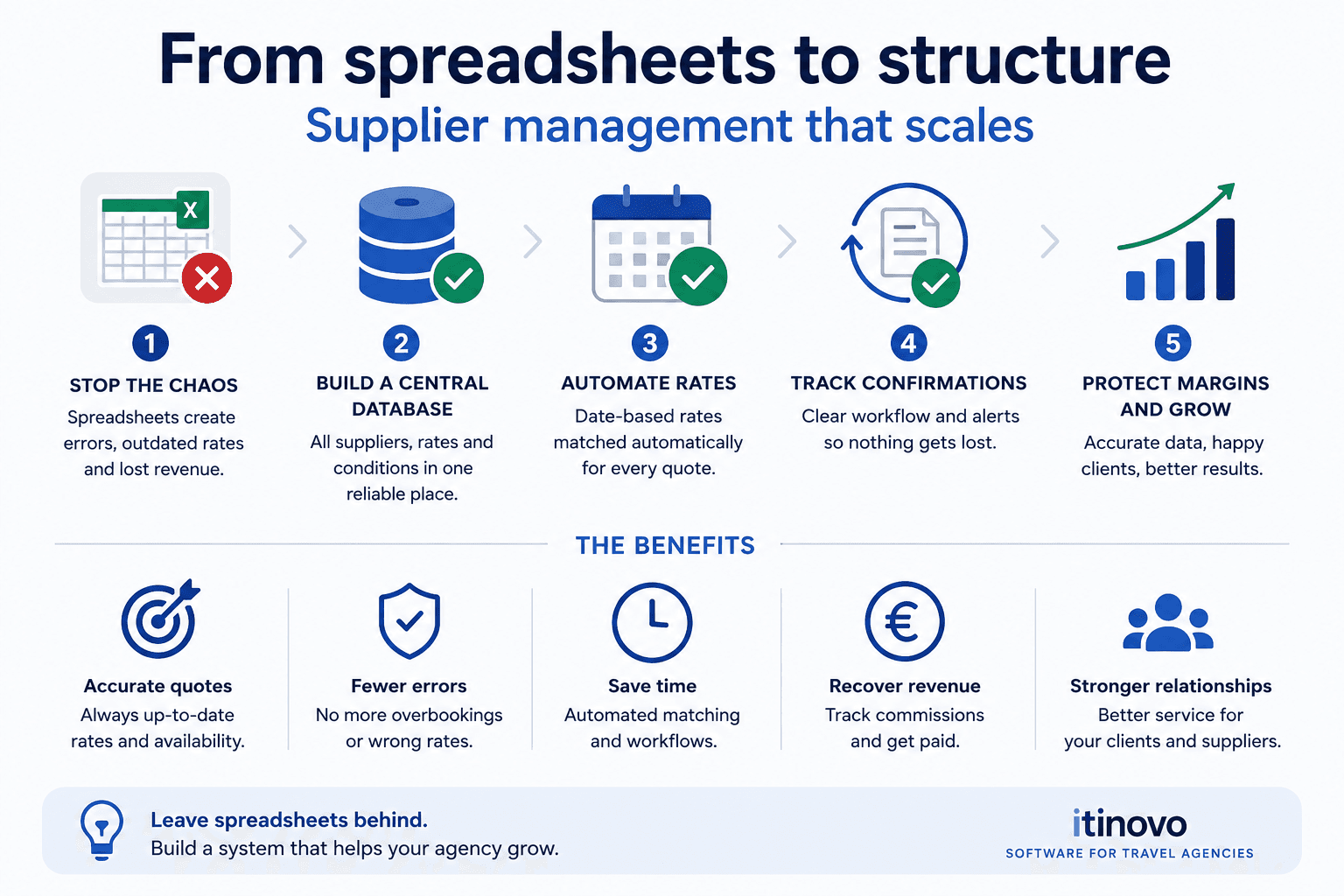
Supplier Management for Travel Agencies: Best Practices
From the Excel trap to structured workflows: how to manage supplier relationships, track rates, confirm bookings, and reconcile commissions without losing your mind.
The Excel trap
Most agencies start managing suppliers in spreadsheets. It works for 5-10 suppliers, but breaks down rapidly at scale. Version conflicts arise when multiple agents update the same file. Rate history is lost when cells are overwritten. Confirmation status lives in someone's email inbox rather than a shared system. Seasonal rate changes require manual updates across dozens of rows. The result is predictable: overbookings from outdated availability, margin erosion from stale rates, and missed commission payments because nobody tracked what was owed.
The spreadsheet approach has a seductive simplicity. You create a sheet per supplier with columns for service name, season, rate, and notes. It works beautifully when you have 8 suppliers and one person managing them. But agencies grow. You add suppliers in new destinations. You hire a second agent who needs access to the same data. You start working with tour operators who have hundreds of products. Suddenly your "simple" spreadsheet is a 47-tab monster with 3,000 rows, and nobody is sure which version is current.
The hidden cost of spreadsheet-based supplier management is not the time spent updating cells, it is the errors that go undetected. A rate that was valid until March but is still being used in May quotes. An allotment that was released last week but still shows as available. A commission agreement that changed in January but was never updated in the file. Each of these errors costs money: either through margin erosion (quoting too low), client disappointment (promising unavailable services), or lost revenue (not collecting earned commissions).
The transition from spreadsheets to a structured system is not just a technology upgrade, it is an operational transformation. It requires discipline: every rate must have validity dates, every supplier must have a complete profile, every confirmation must be tracked through defined statuses. But the payoff is immediate: accurate quotes, reliable availability, and recovered revenue from properly tracked commissions.
Building a structured supplier database
A proper supplier management system starts with a centralised database where every supplier has a complete profile: contact details, payment terms, cancellation policies, commission agreements, and seasonal rate cards. Rates should be date-bounded (valid from/to) with support for multiple occupancy types, meal plans, and room categories. When you build a quote, the system should automatically match the best available rate for the travel dates: no manual lookup required. This eliminates the most common source of margin erosion: quoting with outdated prices.
The supplier profile should capture everything you need to work with that supplier effectively. Basic information: company name, address, VAT number, primary contact, booking contact, emergency contact, preferred communication channel (email, phone, WhatsApp). Financial terms: payment method (bank transfer, credit card), payment timing (prepayment, on arrival, 30 days after service), cancellation policy (free cancellation until X days before, percentage penalties thereafter), and commission structure (percentage, payment frequency, minimum threshold).
Rate cards are the core of the supplier database. Each rate should specify: service name, season (with exact dates), price per unit, unit type (per night, per person, per vehicle, per group), occupancy options (single, double, triple, child, infant), meal plan options (room only, bed and breakfast, half board, full board, all inclusive), room or service variants, supplements (sea view, balcony, suite upgrade), and any blackout dates within the season. This granularity ensures that when you build a quote, the system can match the exact rate for the specific combination of dates, occupancy, and options requested.
The distinction between direct suppliers and tour operator products is important. Direct suppliers (hotels, transfer companies, activity providers) offer net rates: you pay the cost and add your markup. Tour operators offer commissionable rates: the published price includes the operator's margin, and you earn a commission (typically 8-15%) on the selling price. Your system should handle both pricing models transparently, calculating your margin correctly regardless of whether you are marking up a net rate or earning commission on a published price.
The confirmation workflow
Every booking involves a confirmation cycle: you request availability from the supplier, they confirm (or not), you relay the confirmation to the client, and eventually you pay the supplier. Without a structured workflow, confirmations get lost in email threads. A proper system tracks each service through defined statuses (pending, requested, confirmed, paid) with timestamps and responsible agents. When a confirmation is overdue, the system alerts you automatically rather than relying on someone remembering to follow up.
The confirmation workflow typically follows this sequence: (1) Quote accepted by client, all services move to "pending" status. (2) Confirmation requests sent to suppliers: services move to "requested" status, with timestamp recording when the request was sent. (3) Supplier responds: service moves to "confirmed" (with confirmation code) or "unavailable" (requiring alternative sourcing). (4) All services confirmed: client notified, travel documents can be generated. (5) Supplier paid: service moves to "paid" status, payment reference recorded.
Each transition should be tracked with timestamps and the responsible agent. This creates accountability and enables performance measurement. How long does it take, on average, to get confirmation from Hotel Belvedere? If the answer is 5 days while Hotel Panorama confirms within 24 hours, that data informs your supplier selection for time-sensitive bookings. Which agent has the most overdue confirmations? That might indicate a workload imbalance or a training need.
Automated supplier emails are a game-changer for the confirmation workflow. When a booking is confirmed and services move to "requested" status, the system can automatically generate and send confirmation request emails to each supplier. The email is pre-populated with all relevant details: client names, dates, room type, meal plan, special requests, and your agency's booking reference. The supplier simply needs to reply with confirmation: no back-and-forth asking for details that should have been included in the first place.
Overdue confirmation alerts prevent the most dangerous scenario: a client departs without confirmed services. Configure alerts at sensible thresholds: perhaps 48 hours for hotels (which typically confirm quickly) and 5 days for activities or transfers (which may require more coordination). The alert should go to both the responsible agent and a supervisor, ensuring that overdue confirmations are escalated before they become emergencies.
Commission tracking and reconciliation
For agencies working with tour operators and commissionable suppliers, commission tracking is a significant revenue stream that is often poorly managed. The typical problem: you sell a package through a tour operator, earn 10-12% commission, but never systematically track whether the commission was actually paid. A structured approach records the expected commission at booking time, tracks the payment status, and flags overdue commissions (typically those unpaid after 30-60 days). Monthly reconciliation (comparing expected versus received commissions by supplier) often reveals thousands in uncollected revenue.
The commission lifecycle begins at booking time. When you sell a commissionable product, the system should automatically calculate the expected commission based on the selling price and the agreed commission percentage. This creates a receivable: money the supplier owes you. The commission status starts as "pending" (booking made but not yet earned), moves to "earned" (service delivered, commission due), and finally to "paid" (payment received from supplier).
The gap between "earned" and "paid" is where money gets lost. Tour operators typically pay commissions monthly or quarterly, often with a 30-60 day delay after the travel date. Without systematic tracking, it is easy to lose sight of which commissions have been paid and which are outstanding. A supplier might pay 80% of what they owe, and without a reconciliation process, the missing 20% goes unnoticed.
Monthly reconciliation is the discipline that recovers lost revenue. For each supplier, compare: total commissions earned in the period versus total payments received. The difference is your outstanding balance. If a supplier consistently underpays or delays payment, you have data to support a conversation, or a decision to reduce the volume you send them. Agencies that implement systematic commission reconciliation typically recover 5-15% more commission revenue in the first year, money that was always owed but never collected.
The reconciliation process should also track aging: how long each commission has been outstanding. Commissions unpaid for 30 days are normal. Commissions unpaid for 60 days warrant a reminder. Commissions unpaid for 90+ days require escalation. Your system should generate aging reports by supplier, making it immediately visible which suppliers are reliable payers and which require constant chasing.
Negotiating better rates with data
When you approach a supplier for rate negotiations, data is your strongest asset. If you can show that you sent them 45 bookings last year with a total value of 120,000 EUR, you have leverage to negotiate better rates or higher commission percentages. Without a system tracking this data, you are negotiating blind. The best agencies review supplier performance quarterly: volume sent, confirmation speed, client feedback scores, and problem frequency. Suppliers who consistently deliver get more business; those who cause problems get replaced.
The negotiation conversation changes fundamentally when you have data. Instead of "Can you give us a better rate?" (weak, no leverage), you can say "We sent you 45 bookings worth 120,000 EUR last year, making us your third-largest agency partner. Our clients gave you an average satisfaction score of 4.6/5. We would like to discuss preferred rates for the coming season that reflect this volume and quality of business." This is a partnership conversation, not a begging exercise.
Performance data also helps you make objective decisions about supplier relationships. If Supplier A offers rates 10% lower than Supplier B, but Supplier A has a 15% problem rate (late confirmations, room changes, service failures) while Supplier B has a 2% problem rate, the "cheaper" supplier is actually more expensive when you factor in the cost of problem resolution, client compensation, and reputation damage. Your CRM data makes this calculation explicit rather than relying on gut feeling.
Quarterly supplier reviews should examine: (1) Volume, how many bookings did you send, and how does this compare to the previous quarter and the same quarter last year? (2) Revenue (what was the total value of bookings, and what was your margin? (3) Confirmation speed) how quickly did they respond to booking requests? (4) Problem frequency (how many issues arose during or after travel? (5) Client feedback) what did clients say about this supplier's services? (6) Commission compliance, did they pay commissions on time and in full? This scorecard approach makes supplier management objective and data-driven.
Allotment management
For agencies with pre-negotiated room blocks or activity slots, allotment management adds another layer of complexity. You need to track available inventory by date, manage release dates (after which unsold rooms return to the supplier), and prevent overbooking. A visual availability calendar (showing green for available, amber for low stock, and red for sold out) gives agents instant visibility without checking spreadsheets or calling the supplier. Stop-sale functionality prevents bookings when inventory is exhausted.
Allotments are a powerful tool for agencies that can commit to volume. By guaranteeing a supplier a minimum number of bookings (or paying for unsold inventory), you secure preferential rates and guaranteed availability during peak periods. The trade-off is risk: if you cannot sell the allotted rooms, you either pay for empty inventory or release them back to the supplier (often at a penalty or with reduced future allocations).
Effective allotment management requires real-time visibility. For each allotment, you need to see: total rooms/slots available, rooms/slots already booked, rooms/slots remaining, release date (when unsold inventory must be returned), and utilisation rate (percentage sold). A visual heatmap showing availability by date makes it immediately obvious where you have excess inventory (opportunity to promote) and where you are running low (opportunity to request additional allocation or stop selling).
Release date management is critical. Most allotment agreements specify that unsold rooms must be released back to the supplier X days before the arrival date (typically 14-30 days). Missing a release date can result in financial penalties or being charged for unsold rooms. Your system should alert you well before release dates (perhaps 7 days in advance) giving you time to either sell the remaining inventory through targeted promotions or formally release it back to the supplier.
Overbooking prevention is the most important function of allotment management. If your allotment is 10 rooms per night and you have already sold 10, the system must prevent an 11th booking, or at minimum, flag it as requiring manual confirmation with the supplier. The consequences of overbooking are severe: last-minute scrambling for alternatives, potential upgrades at your cost, client disappointment, and damaged supplier relationships. A simple stop-sale mechanism eliminates this risk entirely.
Automating supplier communications
Sending confirmation request emails manually is tedious and error-prone. A structured system can auto-generate supplier emails when a booking moves to 'confirmed' status, pre-filling the email with all relevant details: client names, dates, room type, meal plan, and special requests. Templates per supplier category (hotel, transfer, activity) ensure the right information is included every time. The supplier replies, you update the status, and the system records the confirmation code: all in one place rather than scattered across inboxes.
Email templates should be category-specific because different supplier types need different information. A hotel confirmation request needs: guest names, check-in/check-out dates, room type, occupancy, meal plan, special requests (early check-in, cot, dietary requirements), and your booking reference. A transfer confirmation needs: passenger names, pickup location and time, drop-off location, vehicle type, flight number (for airport transfers), and contact phone number. An activity confirmation needs: participant names, date and time, any physical limitations, language preference, and pickup point if applicable.
The automation should handle the entire communication cycle. When a booking is confirmed: (1) the system generates confirmation request emails for all services, (2) sends them to the respective suppliers, (3) records the send timestamp, (4) monitors for responses, and (5) alerts the agent if no response is received within the expected timeframe. When the supplier replies with a confirmation code, the agent enters it once, and the system updates the status, records the code, and makes it available for voucher generation.
For agencies with high booking volumes, the time savings from automated supplier communications are substantial. If each confirmation request takes 5 minutes to compose manually (looking up supplier email, copying booking details, formatting the request), and you process 50 bookings per month with an average of 4 services each, that is 200 emails x 5 minutes = approximately 17 hours per month spent on a purely mechanical task. Automation reduces this to near zero: the agent's role shifts from composing emails to reviewing responses and handling exceptions.
The cost of poor supplier management
The financial impact of disorganised supplier management is substantial but often invisible. Overbookings require expensive last-minute alternatives and damage client trust. Stale rates mean you either absorb the difference (margin erosion) or go back to the client with a price increase (conversion loss). Missed commission payments are pure lost revenue: money you earned but never collected. Slow confirmation responses delay the entire booking cycle, reducing client satisfaction and increasing the risk of cancellation. Investing in proper supplier management tools pays for itself within months through recovered margins and commissions alone.
Let us quantify the impact for a typical mid-size agency processing 40 bookings per month. Margin erosion from stale rates: if 20% of quotes use outdated rates with an average discrepancy of 50 EUR per booking, that is 40 x 0.2 x 50 = 400 EUR per month in absorbed costs. Missed commissions: if 10% of earned commissions go uncollected due to lack of tracking, and average monthly commission revenue should be 3,000 EUR, that is 300 EUR per month in lost revenue. Overbooking costs: if one overbooking per quarter requires a 200 EUR upgrade or alternative, that is 67 EUR per month. Total: approximately 767 EUR per month in preventable losses, over 9,000 EUR per year.
These figures are conservative. They do not account for the indirect costs: client trust damaged by overbookings (leading to lost future bookings), time wasted on manual processes (opportunity cost of revenue-generating activities not performed), and stress on the team (leading to errors, burnout, and turnover). When you factor in these indirect costs, the true cost of poor supplier management easily exceeds 15,000-20,000 EUR per year for a mid-size agency.
The investment in proper supplier management tools (whether a dedicated module within your CRM or a standalone system) typically costs 50-150 EUR per month. The ROI calculation is straightforward: spend 100 EUR per month to recover 767+ EUR per month in preventable losses. The payback period is immediate. The only question is why agencies delay this investment, and the answer is usually inertia, not economics. The spreadsheet is familiar, the new system requires learning, and the losses are invisible until you measure them. But once measured, the case for change is overwhelming.
Ready to modernise your agency?
itinovo CRM handles margin scheme VAT, quotes, invoicing and suppliers, so you can focus on your clients.
Start free trial