
The PDF Quote Attachment Is Dead: Why You Need a Client Portal
Emailing PDF quotes creates friction, kills conversion, and makes you invisible. A client portal transforms a static document into an interactive experience: acceptance, payment, and feedback in one click.
The PDF quote attachment is dead: why you need a client portal
Every day, thousands of European travel agencies send quotes as email attachments. The client receives the file, opens it (maybe), reads it (maybe), saves it to their desktop (maybe), and then goes silent for days. The agency has no idea whether the quote was seen, whether the client has questions, or whether they're comparing with another offer. The only tool is a follow-up email, which ends up in spam or gets ignored.
This workflow is broken. Not because the PDF is a bad format, but because it's not interactive. It doesn't create a communication channel. It doesn't provide visibility into the process. It doesn't let the client act (accept, request changes, pay) without writing a separate email, downloading a form, or calling the office. In 2026, where every online purchase completes in three clicks, asking a client to print a PDF, sign it, scan it, and send it back is anachronistic.
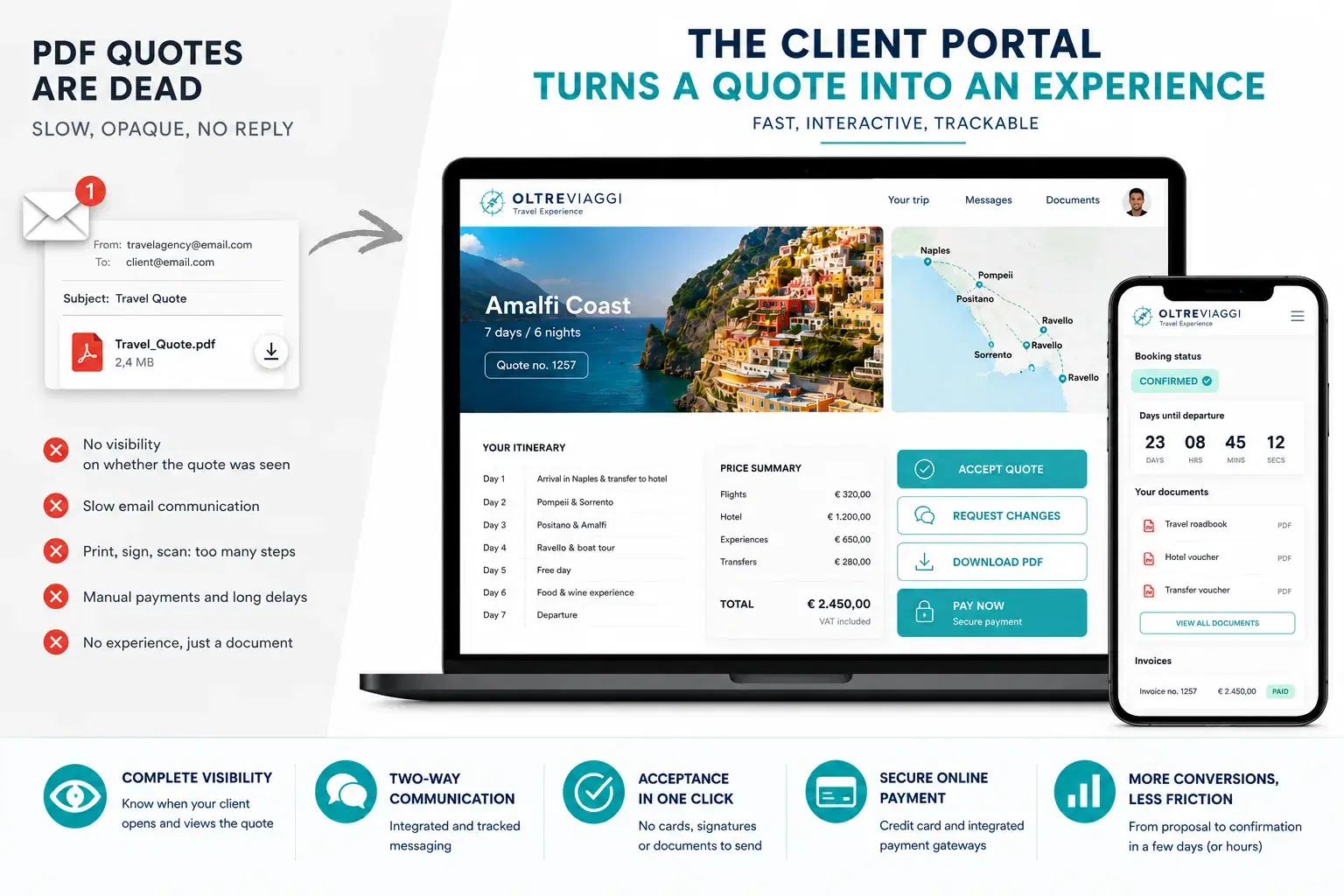
A client portal solves this problem at its root. It's a branded link that transforms a static document into a complete digital experience: from viewing the itinerary to acceptance, from online payment to two-way communication. And crucially, it gives the agency data that a PDF never could: when the client opened the quote, how many times they viewed it, whether they started any action.
What the client sees in the portal
A client portal for travel agencies isn't a simple webpage with an embedded PDF. It's an experience built around the trip. The client opens the link and finds their itinerary presented with destination photos, an interactive route map, day-by-day details with every service described: hotels, activities, restaurants, transfers. Nothing is left to imagination: they see exactly what they're purchasing.
The pricing section is clear and prominent. Depending on the format chosen by the agency, the client sees per-service detail, a category summary, or a lump-sum package price. The amount to pay is visible without ambiguity: no hidden costs, no surprises after acceptance.
Then there are the actions. The client can accept the quote with one click. They can request changes by writing directly in the portal: without opening their email client, searching for the agency's address, or formulating a formal message. They can download the PDF for an offline copy. And crucially, they can pay online (by credit card, through an integrated secure gateway) without making a manual bank transfer and waiting for the agency to verify receipt.
After acceptance, the portal transforms. It shows the booking status: travel documents available for download (roadbook, vouchers), invoices with online payment, countdown to departure. The client has a single reference point for the entire trip: no need to search through dozens of emails to find the hotel voucher or the transfer confirmation.
The problem the portal actually solves: friction
Friction is the invisible enemy of conversion. Every additional step between "I like this proposal" and "I confirm" is an opportunity for the client to postpone, get distracted, or forget. And in travel, friction is still extremely high.
Consider the traditional workflow. The client receives the quote by email. They open it a few hours later (if it doesn't end up in promotions or spam). They read it. They have a question about a hotel. They write an email. The agency responds the next day. The client reads the reply two days later. They decide they want to accept. But how? Should they reply "ok I confirm"? Do they need to sign something? The agency sends a contract. The client prints it, signs it, scans it (if they have a scanner in 2026), sends it back. The agency requests payment. The client makes a bank transfer. The agency waits 2-3 business days for it to clear. Total: 7-14 days from first proposal to confirmation.
With a client portal, the same workflow becomes: client opens the link, sees the itinerary, has a question, writes it directly in the portal (agency receives instant notification), gets a response, accepts with one click, pays by card. Total: 1-3 days. In some cases, hours.
The difference isn't just speed. It's conversion rate. A quote that requires less effort to accept gets accepted more often. It's basic psychology: friction reduces motivation, and in leisure travel the client's motivation is highest at the moment they receive the proposal (they're excited about the trip) but decays rapidly as days pass.
Two-way communication: the portal as a channel
An often underestimated aspect of the client portal is integrated messaging. It's not a generic chat: it's a contextual conversation, linked to that specific quote, visible to both client and operator.
This solves three concrete problems. First: the client doesn't need to search for the agency's email address or remember who's handling their booking. They open the portal, write, the agency receives it. Second: the operator sees the question in the context of the quote, they know exactly which service the client is asking about without re-reading endless email threads. Third: all communication is tracked and associated with the booking, no information lost between personal emails, the operator's WhatsApp, and notes on a sticky note.
For the agency, every client message in the portal generates a notification. The operator responds from the CRM, and the client receives an email with the reply and a link back to the portal. The cycle is closed, fast, tracked. If the operator is away, a colleague can see the history and respond without asking "what were we discussing?"
This traceability also has legal value. In case of a dispute ("but I asked for a sea view room!") the portal communication is documented with timestamps, with no room for "I sent an email but you never replied." Everything is there, in black and white.
Online payment: from cost to competitive advantage
Integrated payment in the portal isn't a luxury: it's a cash flow accelerator. Agencies that only accept bank transfers wait an average of 3-5 business days for funds to clear, during which they cannot confirm suppliers (who often have time-sensitive cancellation policies). With card payment in the portal, the amount is confirmed in real time.
For the client, paying by card is natural. They do it for every online purchase: from Amazon to the corner pizzeria. Asking for a bank transfer in 2026 is like asking for a cheque: technically possible, but creates friction and communicates an outdated image.
The portal can also handle instalment payments. The agency defines a plan (deposit plus balance, or monthly instalments), the client saves their card, and charges are processed automatically at the agreed dates. No manual chasing, no "I forgot to make the transfer." The agency collects on time, the client doesn't think about it again.
Of course card payments have a cost: typically 1.5-2.5% per transaction. But this cost must be weighed against the time savings (no manual reconciliation, no chasing), the reduced risk of non-payment, and above all the faster cash cycle that enables earlier supplier confirmations: often securing better rates or avoiding availability loss.
Post-trip feedback: closing the loop
An evolved client portal doesn't stop at the sales phase. After the trip, the client can return to the portal to leave feedback: a star rating and a comment. This information is valuable for three reasons.
First: it improves suppliers. If three consecutive clients give 2 stars to Hotel Bellavista in Positano, the agency has objective data to negotiate an improvement or switch supplier. Without structured feedback, this information is lost: the client mentions something verbally on return, the operator nods, nobody takes notes.
Second: it feeds marketing. A 5-star rating with an enthusiastic comment is a usable review (with consent) on the agency's website. In travel, social proof drives sales: more than social media, more than advertising.
Third: it reactivates the client. The feedback moment is an opportunity to ask "shall we propose your next trip?" The client is still in the positive emotion of returning, fresh photos on their phone, the perfect moment to plant the seed for the next sale. A portal with integrated feedback allows automating this follow-up, the email goes out at the right moment, not when the operator remembers.
The portal as professional image
There's a less quantifiable but equally important aspect: the image the portal communicates. An agency that sends a link to a branded portal (with their own logo, their colours, professional photos, an interactive map) projects a completely different image from an agency sending a PDF via Gmail.
The portal tells the client: "we're organised, we're technological, we care about details." In a sector where trust is everything (you're entrusting your holiday to someone) this perception of professionalism has real economic value. The client perceives the price as more justified when the purchase experience is premium. They accept a €5,000 quote more readily when the presentation process matches the investment.
This is particularly true in the mid-to-high segment: honeymoons, anniversaries, corporate trips. For an €800 trip to Barcelona, a PDF via email might suffice. For a bespoke €12,000 trip to Japan, the client expects a purchase experience that reflects the product level. The portal delivers exactly that.
The alternative: continuing with email and PDF
Not adopting a client portal doesn't mean standing still, it means falling behind. Competitors who adopt one convert faster, have shorter cash cycles, lose fewer quotes to oblivion, communicate better with clients, collect more feedback. Over time, this gap translates into higher margins and more loyal clients.
The cost of inaction isn't immediately visible. It's not an invoice that arrives. It's the quote the client never accepted because "let me think about it", and they never came back. It's the client question that went unanswered because the email got buried in Monday morning's 47 unread messages. It's the balance payment that didn't arrive and nobody noticed until 3 days before departure.
A client portal isn't a technology investment for the future. It's an operational tool for today. Every quote sent as a link instead of an attachment has a higher probability of being seen, understood, accepted, and paid. And every minute saved on administrative tasks is time the operator can dedicate to what truly matters: building client relationships and selling better trips.
Ready to modernise your agency?
itinovo CRM handles margin scheme VAT, quotes, invoicing and suppliers, so you can focus on your clients.
Start free trial