
Travel Search Is Dead: How AI Agents Are Rewriting Distribution
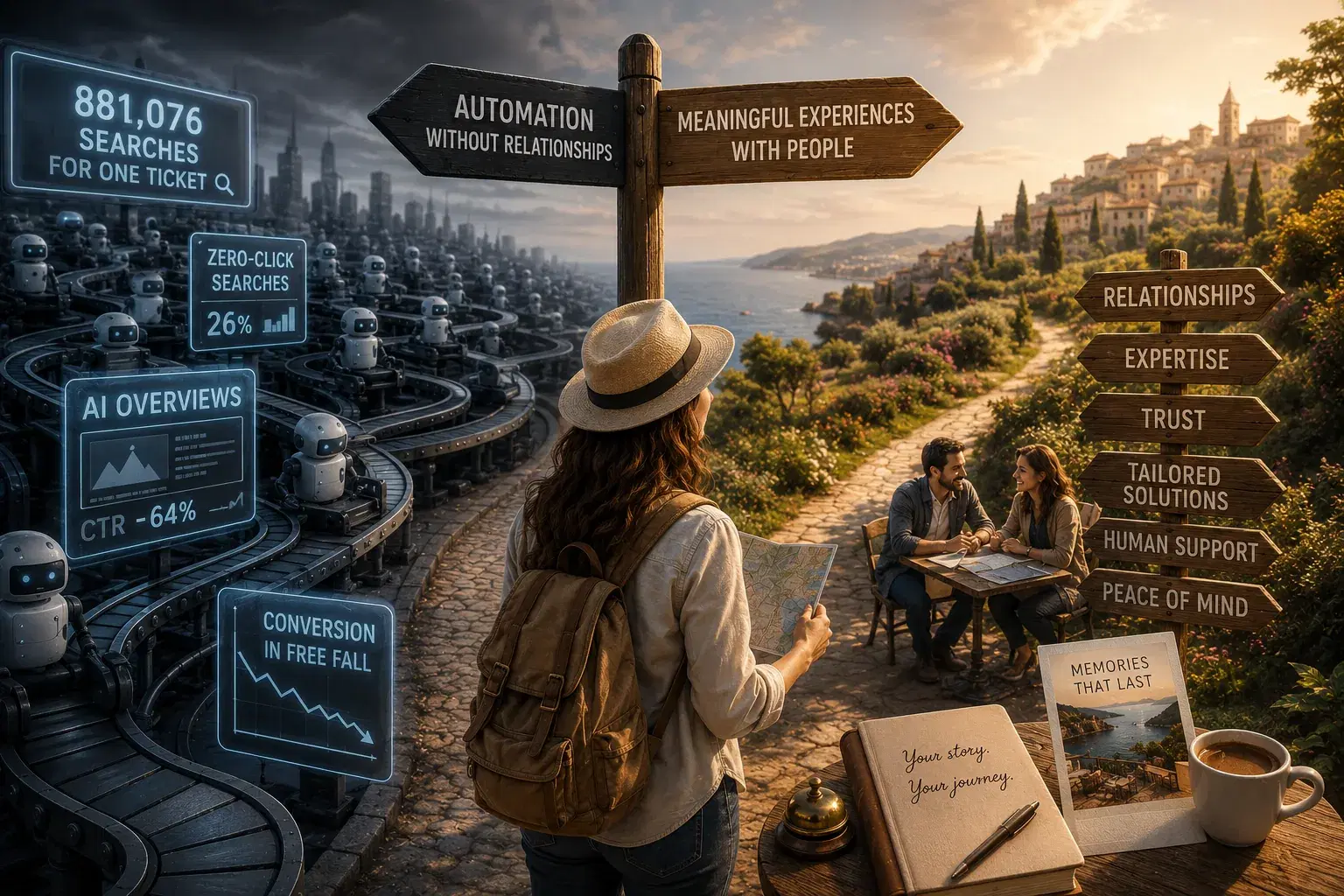
881,000 searches for one airline ticket. The look-to-book ratio has exploded, Google intercepts queries before OTAs see them, and CTR drops 64%. But ‘human-led’ agencies face little risk, provided they have the right digital infrastructure.
881,000 searches for one airline ticket: the day AI broke travel distribution economics
In June 2026, a traveller used Claude (Anthropic's AI assistant) to search for a flight on Etihad Airways. The agent executed 881,076 searches before finding the right option. One ticket. The infrastructure cost of those searches exceeded the commission Etihad would have earned on the sale.
This isn't an isolated anecdote. It's the symptom of a structural shift rewriting the rules of travel distribution. The look-to-book ratio (the number of searches required to generate a booking) has been for decades the fundamental metric underpinning the entire economics of OTAs, metasearch engines, and airlines. That metric is deteriorating at unprecedented speed, because AI agents search without the biological limits that kept the ratio manageable: they don't tire, don't get distracted, aren't in a hurry. They search everything, everywhere, simultaneously.
Skift called it "the two-sided AI squeeze": a double-sided vice. On one side, operational costs to handle the search volume explode. On the other, conversion rates plummet because many of those searches never produce a booking. For OTAs and suppliers earning on transaction volume, it's an existential crisis.
For travel agencies, paradoxically, it's an opportunity.
The death of the click: what happens when Google answers for you
Meanwhile, another earthquake has hit travel distribution. Google's AI Overviews now appear in 48% of all tracked searches: a 58% year-over-year increase. When a traveller searches "best boutique hotels in Lisbon under £300," Google no longer sends them to Booking.com. It shows the answer directly, with photos, prices, and an AI-generated summary. The traveller gets what they were looking for without ever clicking on a website.
The numbers are brutal: when an AI Overview appears, CTR on traditional results drops 34-64%. "Zero-click" sessions (where the user visits no external site) have risen to 26% (they were 16% without AI Overview). Only 8% of users click a traditional result when an AI summary is present. One in twelve.
For OTAs, which built their empire on paid search traffic, this is devastating. Booking.com, Expedia, TripAdvisor: all depend on Google to acquire customers. If Google intercepts demand before it reaches the OTAs, the model crumbles.
But Google didn't stop at Overviews. At Google I/O 2026, it announced integrated agentic booking: Google's AI Mode can complete hotel, flight, and tour bookings within a single conversational interface, without ever sending the user to an external site. Gemini 3.5 Flash, always-on autonomous agents, and a "Universal Commerce Protocol" enabling machines to transact directly. This isn't a product update. It's an architectural change to the entire distribution chain.
Who's most at risk: the agentic disruption map
PhocusWire published in June 2026 an "Agentic Disruption Risk Matrix" mapping every travel player across two axes: how much their product invites agentic automation, and how high their disruption risk is.
The result is counterintuitive. The players most at risk aren't those with the most human involvement, they're those with the least. Pure OTAs (Booking, Expedia), metasearch engines (Trivago, Kayak), flight aggregators (Skyscanner, Google Flights): all operate in territory where an AI agent can replicate 100% of their value: search, compare, sort by price, book.
Conversely, players classified as "human-led": including traditional travel agencies, bespoke tour operators, independent travel consultants, are rated low risk. Why? Because their value doesn't lie in search. It lies in relationships, contextual judgement, supplier negotiations, and crisis management. All things an AI agent cannot do.
But there's a critical asterisk: this only holds for agencies that can compete on the speed and digital experience the traveller now expects. An agency that responds in 3 days with a PDF via email isn't "human-led", it's simply slow. And the traveller who just had a seamless experience with Google's AI will no longer tolerate that slowness.
The "trust gap" protecting agencies: for now
Skift Research revealed a figure that tempers the hype: only 2% of American travellers want to fully delegate booking to an AI agent. Two in a hundred. The remaining 98% want to explore with AI, get inspired, compare, but when it comes time to spend real money, they look for a brand or a person they trust.
This "trust gap" is the natural trench of travel agencies. AI is extraordinary for the discovery and planning phase. But the trip doesn't end with the booking. It begins. And when a flight gets cancelled at 11 PM, when a hotel turns out different from the photos, when a country enters crisis: the AI agent doesn't answer the phone. It has no relationship with the hotel receptionist. It can't negotiate an upgrade or arrange an alternative transfer in 20 minutes.
IDC confirms it: by the end of 2026, discovery, comparison, booking, and service will be mediated by intelligent agents acting on behalf of travellers. But "mediated" doesn't mean "replaced." The AI agent is a digital intermediary that selects options. The travel agency is a human fiduciary that guarantees the experience. They're two different roles, not in direct competition, provided the agency positions itself correctly.
The agency's new role: curator, fiduciary, crisis manager
The agentic world redefines the travel agency's positioning. No longer "I'll find you the cheapest flight": AI does that better, free, in 3 seconds. The new positioning is threefold:
Curator: selecting, validating, and combining experiences that no algorithm can assemble. The hidden restaurant without a web page. The family-run hotel not on Booking. The alternative route that avoids crowds. Local knowledge, direct supplier relationships, aesthetic judgement: everything that isn't indexable.
Fiduciary: managing the client's money with transparency and responsibility. When a trip costs £8,000 and involves 15 suppliers, the traveller wants someone who'll answer if something goes wrong. Not a chatbot. Not an automated voucher. A person with a name and a number.
Crisis manager: reacting in real time when plans fall apart. As demonstrated by the Middle East crisis of March 2026, agencies that knew exactly where their clients were and had alternatives ready were the heroes. OTAs sent automated emails and vouchers. Agencies called before the client even saw the news.
The speed paradox: the AI-educated client judges you by AI standards
Here's the problem. The 2026 traveller no longer compares their agency with the other agency down the street. They compare it with ChatGPT, with Booking's AI, with Google's assistant. They just received 3 personalised itinerary proposals in 10 seconds. They just saw an interactive map of their trip with photos, costs, and descriptions. They just paid with one click.
And then they call their agency. Which tells them "I'll send the quote by email, let's chat next week."
The trust gap protects the agency from losing clients who've already decided to use it. But it doesn't protect from losing clients still deciding. That client, in the time the agency takes to build a quote in Word and send it as an attachment, has already received 3 AI proposals and is weighing whether the service difference justifies the wait.
The answer isn't to become an AI. It's to combine human value (relationship, expertise, accountability) with the speed and digital experience the client now takes for granted. A portal where the client sees their itinerary with photos and a map. A quote that arrives in hours, not days. Payment completed with one click. Communication tracked, not scattered across email, WhatsApp, and sticky notes.
Being "machine-readable" in the agentic world: the new infrastructure
DEPT Agency identified the key principle of 2026: "Feed > Site." Travel businesses that will win aren't those with the prettiest website, they're those whose data is structured, current, and machine-readable. Every service, every price, every policy must be machine-readable. AI rewards verifiable clarity, not storytelling.
For a hotel or airline, this means APIs, NDC feeds, Schema.org structured data. For a travel agency, what does it mean in practice?
It means the quote cannot be a static PDF in an email inbox. It's invisible to any system. It's not searchable, not indexable, not interactive. In an era where the client expects to see their trip on a map, accept with a click, pay by card, and receive real-time updates: a PDF attached to an email is the digital equivalent of a registered letter.
A branded client portal with structured itinerary, transparent pricing, route map, and direct actions (accept, pay, communicate) isn't a technological luxury. It's the minimum infrastructure to exist in the 2026 digital ecosystem. It's the difference between an agency the client finds, compares, and chooses, and an agency the client forgets in the time it takes to respond.
Three pillars for thriving through the agentic disruption
Agencies that will navigate the agentic disruption unscathed share three characteristics:
Structured data, not static documents. Every quote is a digital object with destination, dates, services, prices, status: not a Word file. This enables searching, filtering, analysing, and presenting to the client interactively. When the client's AI agent asks "what's the status of my trip?", the answer must exist somewhere in machine-readable format, not in the operator's head.
Operational speed, not manual work. A quote built in 20 minutes, not 3 hours. Templates by destination, up-to-date supplier rates, margins calculated automatically. Automations that send follow-ups at the right moment, reminders before departure, feedback requests after return. Operator time should be invested in relationship-building and creativity: not filling in spreadsheets.
A direct digital channel with the client. Not scattered emails, not the operator's personal WhatsApp, not PDF attachments that end up in spam. A single, branded space where the client views their trip, communicates with the agency, pays, downloads documents, and leaves feedback. A channel that creates value for the client (convenience) and the agency (traceability, conversion, professional image).
Those who already have these three pillars don't fear agentic AI. In fact, they benefit: AI eliminates OTA competition on simple bookings (the Barcelona weekend), and concentrates complex, high-value demand (the £10,000 bespoke trip) toward those offering human expertise with a digital experience.
Those who don't (who still work with email, PDF, Excel, and memory) aren't just losing efficiency. They're becoming invisible in a world where invisibility is permanent.
2026 isn't the year of AI versus agencies. It's the year of AI versus OTAs.
The dominant narrative ("AI will replace travel agencies") is wrong in its direction. Agentic AI is replacing OTAs, not agencies. It's eliminating the need for a technological intermediary between the traveller and the supplier. But it's increasing the need for a human intermediary between the traveller and the experience.
The exploding look-to-book ratio isn't a problem for the agency with 200 loyal clients. It's a problem for Booking.com paying Google to acquire each of its 300 million visitors. The AI Overview intercepting searches doesn't hurt the agency that gets clients through word of mouth. It hurts the OTA spending $6 billion a year on Google Ads.
The window of opportunity is open now. Travellers are experiencing AI's limits (it suggests, but doesn't guarantee; it plans, but doesn't solve problems). OTAs are facing a structural customer acquisition cost crisis. And agencies investing today in digital tools, operational speed, and a client experience worthy of 2026: those will be the natural winners of this transition.
Not because AI doesn't exist. But because AI needs someone to do what it cannot. And that someone, in travel, is the agency. Provided it's ready.
Ready to modernise your agency?
itinovo CRM handles margin scheme VAT, quotes, invoicing and suppliers, so you can focus on your clients.
Start free trial