
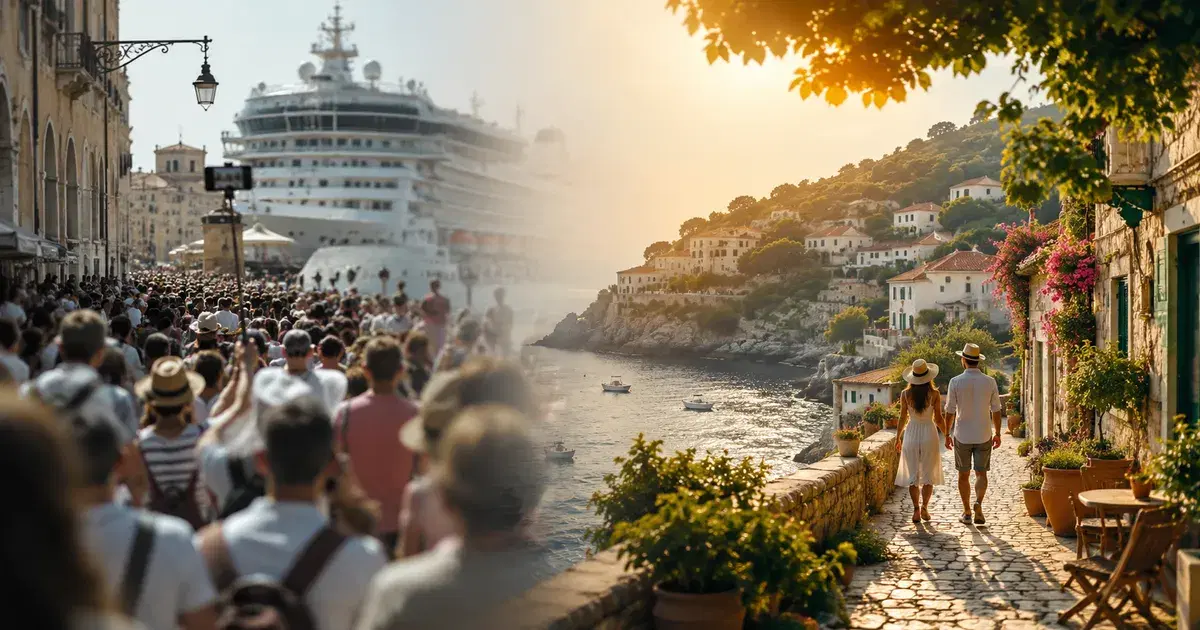
Venice Wants €50 to Enter. Barcelona Doubled Its Tourist Tax. Your Clients Need You More Than Ever.
Tourist taxes doubled, entry fees soaring, group bans expanding. The 2026 restriction map is a minefield, and the best commercial opportunity agencies have had in years. The overtourism paradox explained with data.
Venice wants €50 to let you in. Barcelona doubled its tourist tax. The European travel map just got rewritten.
Venice's newly elected mayor Simone Venturini announced in June 2026 his intention to raise the city's day-tripper entry fee to as much as €50, up from the current €5-10. Barcelona has effectively doubled its tourist tax to €12.50-15 per night, with cruise passengers facing a further €8 surcharge. Amsterdam charges 12.5% of the room price, roughly €18 per person per night, the steepest in Europe. Greece introduced a climate-resilience fee reaching €15 per night for five-star hotels. Vienna is moving from 3.2% toward 8%.
This isn't a collection of isolated policy decisions. It's a coordinated continental response to a structural problem. And for travel agencies, it represents the single biggest repositioning opportunity in a decade.
The 2026 restriction map: a minefield your clients can't navigate alone
The EU's 2026 Green Tourism Plan, unveiled at the Cyprus ministerial meeting, formally endorsed "visitor dispersal" as a strategic priority. The European Parliament has proposed redirecting travellers from overcrowded hotspots to lesser-known destinations. Brussels isn't just acknowledging the overtourism problem, it's building policy infrastructure to solve it.
Meanwhile, cities are acting unilaterally with an alphabet soup of measures:
Venice: entry fee on 60 days between April and July 2026 (expanded from 29 days in 2024). Booking required in advance. Groups capped at 25 people. Loudspeakers banned. Fine for non-compliance: €50-300.
Barcelona: tourist tax doubled to €12.50-15/night. Cruise fee rising to €8/person. Short-term rental licences being phased out entirely by 2028.
Amsterdam: 12.5% accommodation tax plus a flat €3 per-night city fee. New cruise ships banned from central terminal. "Stay Away" campaigns targeting certain tourist profiles.
Greece: new climate-resilience levy of €1.50-15 per night depending on property rating and season. Applied across all islands and mainland destinations.
Rome: tourist tax revision under discussion, with proposals reaching €10/night for peak season.
Each city has different dates, different exemptions, different booking requirements, different enforcement mechanisms. For a self-service traveller assembling a multi-city European trip on Booking.com, this complexity is invisible until checkout, or worse, until arrival. For an agency, it's information that transforms a transaction into a service.
The climate is rewriting the calendar, and the map
Overtourism regulations aren't the only force reshaping European travel patterns. According to Booking.com's April 2026 research, 42% of travellers now plan to travel outside traditional peak season, and 25% are actively seeking cooler destinations. Skift's analysis confirms this isn't a retreat from travel, it's a redistribution. Demand is migrating into shoulder seasons and northward.
CNBC reported in July 2026 that flights to traditionally seasonal European destinations now operate year-round, with airlines extending schedules well beyond the classic June-August window. The "coolcation" (choosing a destination specifically for milder temperatures) has moved from niche trend to mainstream behaviour.
A Booking.com/Nation Thailand survey found 43% of respondents choosing to travel outside peak season or switch to secondary cities specifically to avoid congestion and redistribute income to new areas.
For agencies, this means two things. First: the seasonality that defined agency economics for decades (frantic summer, dead winter) is flattening. Demand exists year-round: if you know where to direct it. Second: the clients asking "where should we go in August?" increasingly expect an answer that accounts for heat, crowds, and cost, not just the brochure destinations.
"Destination dupes": not budget travel, intelligent travel
The term sounds dismissive, but the phenomenon is serious. GetYourGuide's June 2026 data confirms that travellers are increasingly choosing affordable, less-crowded cities over traditional hotspots, driven by cost savings and desire for authentic experiences. Airbnb's 2026 "Dupe-It List" identifies specific alternative destinations for every type of getaway, with stays under £200/night.
The numbers make the case. Cozycozy's analysis of 8 European destination pairs found savings reaching 60% per night on accommodation alone. Skyscanner data shows 52% of Gen Z travellers plan to travel abroad more in 2026, even as fewer than half intend to spend more on flights.
The concrete alternatives being promoted across the industry: Kotor instead of Dubrovnik. Ljubljana instead of Vienna. Albania's Riviera instead of the Greek islands. Puglia instead of the Amalfi Coast. Porto instead of Lisbon. Ghent instead of Bruges. Lesser-known, but not lesser-quality.
Here's what matters for agencies: this isn't a budget trend. It's a value trend. The traveller choosing Ljubljana over Vienna isn't looking for the cheapest option, they're looking for the smartest option. They want comparable quality without the crowds, the inflated prices, and the €15/night tourist tax. They want someone to tell them: "you'll love it here, and here's why."
That's curation. That's expertise. That's what no algorithm can do at scale.
Why the agency is the natural player in the dispersal game
PhocusWire's alternative roadmap for overtourism identifies "dispersal" as the primary lever, shifting demand from primary to secondary destinations. But it acknowledges a fundamental constraint: dispersal requires infrastructure. Someone needs to know the secondary destination, have supplier contacts there, and be able to build a compelling package.
OTAs can't do this. Their model is algorithmic: they surface what's already popular, reviewed, and listed. A family-run hotel in Matera with 12 rooms and no Booking.com listing doesn't exist in their world. A local guide network in the Azores that operates by WhatsApp and personal referral is invisible to Expedia's search engine.
Travel agencies can do this. The agency that's visited Kotor, that knows the boutique property owner by name, that can arrange the private boat to Our Lady of the Rocks without queuing: that agency delivers precisely the "dispersal" that regulators want and travellers increasingly seek.
Phocuswright research found that 43-61% of travellers across major markets actively avoided a destination in the past 12 months due to a sustainability-related concern (overcrowding, environmental damage, resident hostility). These aren't fringe travellers. This is the mainstream. And they're looking for someone to guide them toward the alternative.
The hidden margin advantage of secondary destinations
Here's the commercial reality that makes this opportunity particularly compelling. Secondary destinations aren't just less crowded: they're more profitable for agencies.
In primary destinations (Barcelona, Santorini, Amsterdam), the accommodation market is dominated by OTAs, price transparency is total, and suppliers have minimal negotiation flexibility. The traveller has already seen the Booking.com price. Your margin is compressed.
In secondary destinations (Kotor, Puglia, Alentejo, Slovenian Alps), the dynamic is different. Many properties aren't listed on major OTAs, or if they are, visibility is low. Price comparison is difficult for the consumer. Suppliers are eager for partnerships that bring reliable volume. Negotiation is possible. Net rates from direct relationships can offer 25-40% markup potential versus the 10-15% margin squeeze of hyper-competitive primary destinations.
The maths is simple: a €2,000 package to Barcelona where your margin is 12% yields €240. A €1,800 package to Puglia where your margin is 22% yields €396. Less revenue, more profit. And a happier client who didn't spend their holiday queuing behind cruise ship passengers.
How to structure a "smart alternatives" offering
The agencies already capitalising on this shift share common operational patterns:
Proactive communication about new regulations. When Barcelona doubled its tourist tax, agencies that emailed their client base within 48 hours: "Here's what changed, here's what it means for your trip, here's an alternative we recommend", converted concern into bookings. The clients who learned about the tax at hotel checkout felt abandoned. Those informed in advance felt protected.
A dedicated segment in the pipeline. Clients who express interest in popular destinations but show price sensitivity or flexibility are flagged and receive alternative proposals. Not as a downgrade: as an upgrade in experience quality.
Template quotes for alternative destinations. Building a Kotor package from scratch takes 3 hours. Having a template with pre-loaded suppliers, validated rates, and a compelling day-by-day structure means responding in 30 minutes. Speed wins deals.
Supplier relationships in emerging destinations. The time to build contacts in Albania, Montenegro, Slovenia, Alentejo, and southern Puglia is now: before every agency discovers them. Early-mover advantage in supplier relationships translates directly into better rates and exclusive access.
Seasonal rebalancing. Using the climate shift data to propose September/October Mediterranean trips (better weather than August, fewer crowds, lower prices) or May Northern Europe trips (long days, mild temperatures, pre-tourist-season pricing). Shoulder season isn't compromise: it's optimisation.
The paradox: overtourism is the best thing to happen to agencies in years
This is counterintuitive but demonstrable. Every new restriction, every tax increase, every booking requirement added to popular European cities makes independent travel harder and professional guidance more valuable.
When travel was simple (book a flight, book a hotel, show up) the agency's value was questionable for straightforward trips. But when travel to major European cities requires navigating variable entry fees, advance booking slots, group size restrictions, accommodation licensing rules, climate levies, and cruise surcharges that change annually: the complexity justifies professional help.
The EU's sustainable tourism strategy explicitly assigns a role to travel operators in achieving dispersal objectives. Agencies aren't just beneficiaries of this complexity, they're positioned as part of the solution. The operator who redirects 50 families from overcrowded Santorini to under-visited Milos isn't just making sales. They're implementing policy.
The window is now. The regulations will only increase. The destinations discovering tourism's downsides (Barcelona, Venice, Amsterdam) are not reversing course: they're accelerating. New cities are joining the restriction movement every quarter. And the traveller navigating this landscape alone is increasingly frustrated, confused, and ready to delegate.
The agency that knows the rules, proposes the alternatives, and delivers the experience seamlessly isn't competing with Booking.com. It's solving a problem Booking.com created.
Ready to modernise your agency?
itinovo CRM handles margin scheme VAT, quotes, invoicing and suppliers, so you can focus on your clients.
Start free trial