
Travel Agency vs OTA: A Survival Guide for 2026
Online Travel Agencies are squeezing margins and stealing direct clients. But traditional agencies have advantages that algorithms cannot replicate. Here is how to compete and win.
The OTA squeeze
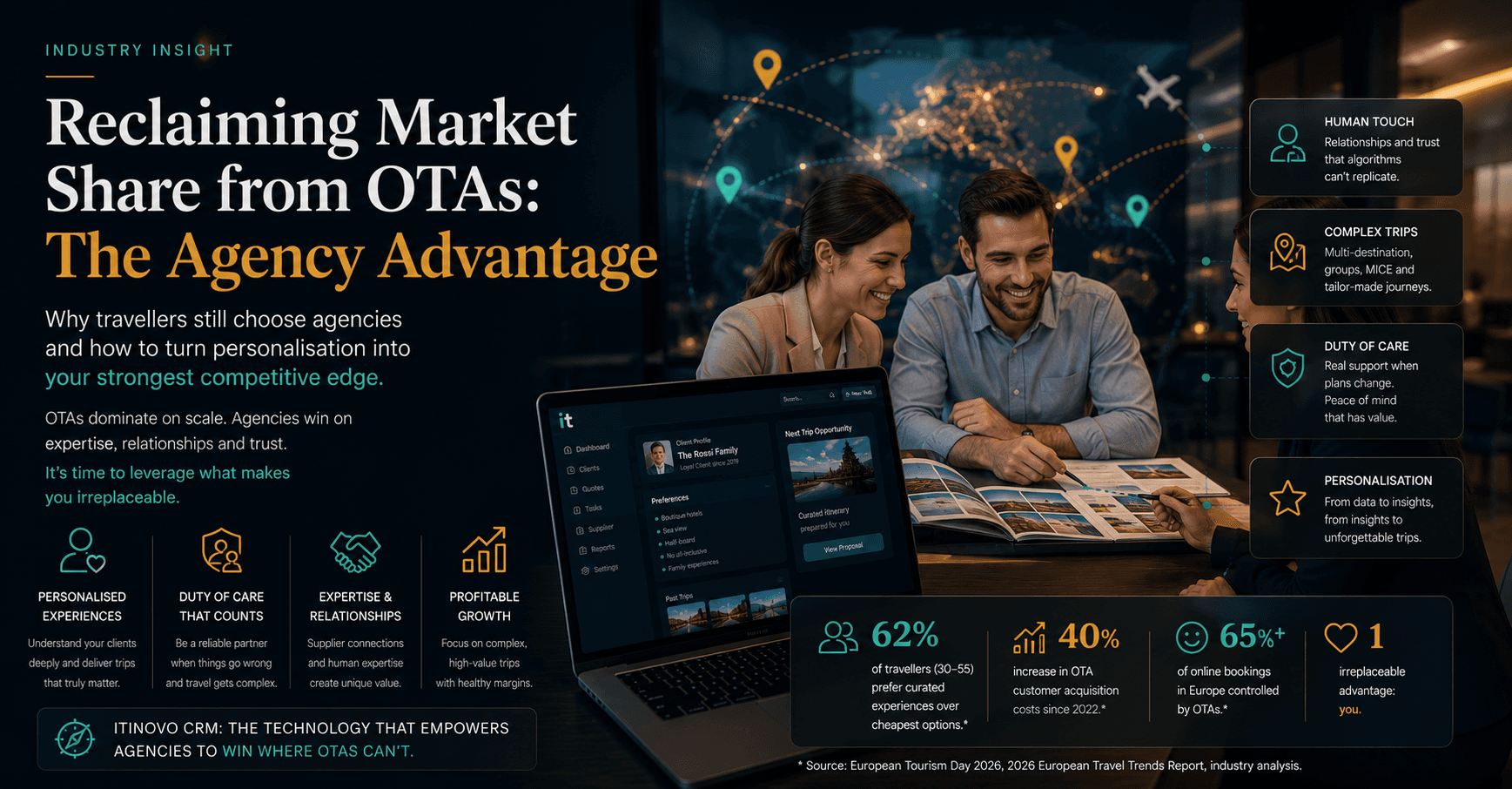
Booking.com, Expedia, and their subsidiaries now control over 65% of online travel bookings in Europe. Commission rates for accommodation partners have crept up to 15-25%, while algorithm changes make it increasingly difficult for independent properties to gain visibility without paying for promoted listings. For travel agencies, the challenge is twofold: clients compare your quotes against OTA prices (which often appear lower because they exclude service fees), and suppliers are pressured into price parity clauses that prevent agencies from offering better rates. The playing field is not level, but it is not hopeless either.
The consolidation of the OTA market has accelerated since 2020. Booking Holdings (Booking.com, Priceline, Agoda, Kayak) and Expedia Group (Expedia, Hotels.com, Vrbo, Trivago) together process over 200 billion EUR in gross bookings annually. Their marketing budgets dwarf anything a traditional agency can spend, Booking.com alone spends over 5 billion EUR per year on performance marketing, primarily Google Ads. When a potential client searches "hotel Rome," they see OTA results before they see your agency website.
But the OTA model has structural weaknesses that are becoming more apparent. Customer acquisition costs have risen 40% since 2022 as Google increases ad prices and reduces organic visibility. OTA margins are being squeezed by their own success, the more dominant they become, the more suppliers push back on commission rates and parity clauses. The EU's Digital Markets Act is beginning to restrict some of the anti-competitive practices that gave OTAs their advantage. And most importantly, the post-pandemic traveller is increasingly dissatisfied with the impersonal, algorithm-driven booking experience.
The opportunity for traditional agencies lies not in competing with OTAs on their terms (price, volume, convenience for simple bookings) but in excelling where OTAs structurally cannot: complex itineraries, personalised service, duty of care, and the human relationship that transforms a transaction into a trusted partnership.
Why clients still choose agencies
Data from European Tourism Day 2026 shows a clear counter-trend: travellers spending over 3,000 EUR per trip increasingly prefer curated experiences over self-service booking. The reasons are consistent across markets: complex multi-destination itineraries that OTAs cannot handle, duty of care when things go wrong abroad, personalised recommendations based on genuine expertise, and the peace of mind that comes from having a human advocate. For MICE events, group travel, honeymoons, and adventure trips, agencies remain the preferred channel precisely because these trips require coordination that no algorithm can provide.
The "experience economy" shift is real and measurable. According to the 2026 European Travel Trends Report, 62% of travellers aged 30-55 with household income above 80,000 EUR prefer "curated, meaningful experiences" over "finding the cheapest option." This demographic (your ideal client) is actively seeking expertise, not just inventory access. They want someone who has been to the Amalfi Coast and can recommend the restaurant with the terrace overlooking Positano, not just someone who can show them 847 hotel listings sorted by price.
The duty of care argument has strengthened considerably since the pandemic and the increase in geopolitical instability. When flights are cancelled due to strikes, when a destination becomes unsafe due to political unrest, when a natural disaster disrupts travel plans: OTA customers are on their own, navigating automated phone trees and chatbots. Agency clients have a human advocate who picks up the phone, rebooks flights, arranges alternative accommodation, and handles insurance claims. This peace of mind has tangible value that justifies a premium.
For group travel and MICE (Meetings, Incentives, Conferences, Events), agencies are not just preferred: they are essential. Coordinating 50 delegates across multiple hotels, conference venues, restaurants, and activities requires human judgment, supplier relationships, and real-time problem-solving that no platform can provide. This segment represents significant revenue with healthy margins, and it is growing as companies invest in team experiences post-pandemic.
The personalisation advantage
An OTA shows the same search results to everyone. A good travel agent remembers that the Bianchi family prefers boutique hotels, that Mr. Mueller needs ground-floor rooms for accessibility, and that the Dupont couple always wants a cooking class on their third day. This institutional knowledge (built over years of client relationships) is your competitive moat. The key is making this knowledge actionable through a CRM that tracks preferences, past trips, and feedback, so every interaction feels personally crafted rather than transactional.
True personalisation goes far beyond remembering a name. It means understanding travel patterns (the Rossi family always travels in the first two weeks of August), preferences (they prefer half-board, never all-inclusive), constraints (their daughter has a nut allergy), and aspirations (they have mentioned wanting to visit Japan "someday"). When you proactively reach out in February with a curated Japan itinerary for August (complete with allergy-safe restaurant recommendations) you demonstrate a level of care that no algorithm can replicate.
The CRM is the enabler of this personalisation at scale. Without it, institutional knowledge lives in individual agents' heads, and walks out the door when they leave. With a proper system, every interaction, preference, feedback comment, and trip detail is recorded and accessible to any team member. When a client calls and their usual agent is on holiday, the colleague can provide the same personalised service because the relationship history is in the system, not in someone's memory.
Email marketing powered by CRM data transforms generic newsletters into personalised recommendations. Instead of sending the same "Summer deals" email to your entire database, segment by preference: beach lovers get Sardinia and Greece, culture enthusiasts get Tuscany and Andalusia, adventure seekers get Iceland and Norway. Open rates for personalised travel emails consistently exceed 35%, compared to 15-20% for generic blasts. Each personalised touchpoint reinforces the relationship and keeps your agency top-of-mind when the next trip is being planned.
Complex itineraries: where OTAs fail
Try booking a 12-day multi-country tour with internal flights, private transfers, guided excursions, and dietary requirements on Booking.com. You cannot. OTAs excel at simple point-to-point bookings (a hotel here, a flight there) but they fundamentally cannot handle the orchestration required for complex travel. This is where agencies create irreplaceable value: coordinating multiple suppliers, managing timing dependencies, handling group logistics, and ensuring every piece fits together seamlessly. Position your agency explicitly around this complexity rather than competing on simple bookings where OTAs will always win on price.
The complexity advantage manifests in several dimensions. Temporal coordination: ensuring the transfer arrives after the flight lands (with buffer for delays), that the hotel check-in aligns with the transfer arrival, that the guided tour starts after breakfast, and that the restaurant reservation accounts for the tour's end time. A single timing error cascades through the entire itinerary. Supplier coordination: managing 15-20 different suppliers for a single trip, each with different booking procedures, confirmation timelines, payment terms, and cancellation policies. Contingency planning: knowing what to do when the volcano erupts, the airline strikes, or the hotel overbooks, having backup options pre-identified and supplier relationships that enable last-minute changes.
Multi-destination itineraries are particularly valuable because they combine high complexity (many moving parts) with high spend (longer trips cost more) and high satisfaction (clients remember these trips for years). A 14-day Italy tour covering Rome, Amalfi Coast, Sicily, and Florence involves 4 hotels, 6 transfers, 8-10 activities, multiple restaurants, and potentially internal flights. The margin on such a package (typically 15-25%) is far healthier than on a simple hotel booking where OTAs have compressed margins to 5-8%.
Position your agency explicitly around this complexity. Your marketing should showcase multi-destination itineraries, not single-hotel deals. Your website should feature sample itineraries that demonstrate the orchestration involved. Client testimonials should emphasise the seamless experience and the problems you solved: not just the price. When a potential client sees the complexity you manage effortlessly, they understand why your service has value beyond what a booking engine provides.
Digital transformation: the hybrid model
The most successful agencies in 2026 are not choosing between traditional and digital, they are combining both. A professional online presence (website, social media, client portal) handles discovery and routine interactions, while human expertise handles consultation, complex planning, and problem resolution. CRM systems with automated follow-ups ensure no lead falls through the cracks. AI assistants handle routine queries and administrative tasks, freeing agents to focus on high-value consultations. The goal is not to become an OTA, but to match their convenience while exceeding their service quality.
The hybrid model recognises that different stages of the customer journey require different approaches. Discovery and initial research happen online: your website, social media, and content marketing attract potential clients. Initial enquiry and qualification can be partially automated: a well-designed contact form or chatbot captures requirements and routes leads to the right agent. Consultation and planning require human expertise, this is where your value is created. Booking confirmation and documentation can be largely automated: your CRM generates contracts, sends confirmations, and manages the paperwork. Post-booking communication uses a mix: automated departure reminders and feedback requests, with human intervention for problems or changes.
Technology should amplify human capability, not replace it. An AI assistant that handles routine queries ("What documents do I need for Egypt?" "What is the baggage allowance on my flight?") frees your agents to spend their time on high-value activities: building complex itineraries, negotiating with suppliers, and having meaningful conversations with clients about their travel dreams. The agent who spends 3 hours per day answering routine questions could instead spend that time converting leads into bookings: a direct revenue impact.
The client portal is perhaps the single most impactful digital investment for a traditional agency. It provides the convenience that clients expect from digital interactions (view quotes anytime, accept online, message without phone tag, track booking status) while maintaining the personal relationship that distinguishes you from OTAs. The portal is not a replacement for human contact, it is a complement that handles the transactional elements so human interactions can focus on the relational elements.
Building your digital presence
Your website is your storefront. If it looks like it was built in 2012, clients will assume your service is equally outdated. Invest in a modern, mobile-first website that showcases your expertise through destination guides, client testimonials, and sample itineraries. Implement a client portal where existing clients can view their quotes, accept proposals, and communicate without phone tag. Use email marketing to stay top-of-mind with past clients: a monthly newsletter with curated destination ideas costs almost nothing but keeps your agency in consideration for the next trip.
Content marketing is your long-term competitive advantage against OTAs. While OTAs compete on price and inventory, you can compete on expertise and inspiration. Publish destination guides based on your first-hand experience. Share client stories (with permission) that showcase the experiences you create. Write about travel trends, regulatory changes, and insider tips that demonstrate your knowledge. This content serves dual purposes: it attracts new clients through search engines, and it reinforces your expertise with existing clients who see your newsletter.
Social media presence should be authentic and expertise-driven, not promotional. Share behind-the-scenes glimpses of trip planning, destination photos from your own travels, client feedback (with permission), and timely travel advice. Instagram and Pinterest work well for visual inspiration; LinkedIn for corporate and MICE clients; Facebook for community building with existing clients. The goal is not viral reach: it is consistent presence that keeps your agency visible to your target audience.
Google Business Profile is often overlooked but critically important for local agencies. Ensure your profile is complete with photos, services, opening hours, and (most importantly) client reviews. Encourage satisfied clients to leave Google reviews after their trip. A 4.8-star rating with 50+ reviews provides social proof that no amount of advertising can replicate. Respond to every review (positive and negative) to demonstrate engagement and professionalism.
Leveraging data against algorithms
OTAs have big data. You have deep data. While Booking.com knows that millions of people search for 'hotels in Barcelona', you know that your client Maria always travels in shoulder season, prefers properties with pools, and has a budget of 150-200 EUR per night. Use your CRM data to proactively suggest trips before clients even start searching. Track which destinations are trending among your client base. Analyse which suppliers deliver consistently and which cause problems. This focused intelligence, applied to a curated client base, outperforms algorithmic recommendations every time.
The power of deep data lies in prediction. If you know that 30% of your clients who visited Greece last year are likely to book again this year (based on historical patterns), you can proactively reach out with new Greek itineraries in January, months before they start searching on OTAs. By the time they see a Booking.com ad in April, they have already booked with you. This pre-emptive approach, powered by CRM analytics, is impossible for OTAs because they do not have the relationship context.
Supplier performance data gives you a negotiating advantage and a quality advantage simultaneously. Track confirmation speed (how quickly each supplier responds to booking requests), problem frequency (how often issues arise during the trip), client feedback scores (how clients rate the experience with each supplier), and value for money (price relative to quality delivered). This data helps you: (1) recommend the best suppliers to clients with confidence, (2) negotiate better rates with high-volume suppliers, (3) identify and replace underperforming suppliers before they damage client relationships, and (4) demonstrate to clients that your recommendations are data-driven, not arbitrary.
Conversion analytics reveal where your sales process can improve. Track: lead source (which channels generate the most valuable leads), response time (how quickly you respond to enquiries, every hour of delay reduces conversion by 10%), quote-to-booking ratio (what percentage of quotes convert), and average booking value by source. This data helps you allocate marketing budget effectively, identify process bottlenecks, and focus your team's energy on the highest-value activities.
The trust factor for high-value trips
When a couple is planning a 15,000 EUR honeymoon or a company is organising a 50,000 EUR incentive trip, they do not book on Expedia. The stakes are too high for self-service. They want a professional who will answer the phone at 10pm when the transfer does not show up, who has personally visited the resort, and who will fight for compensation if something goes wrong. Position your agency as the trusted advisor for trips where failure is not an option. This market segment is growing, profitable, and largely immune to OTA competition.
Trust is built through demonstrated competence over time. Every successful trip reinforces the relationship. Every problem you solve: the cancelled flight you rebooked within an hour, the overbooked hotel you upgraded at no cost, the medical emergency you coordinated from 3,000 km away, creates a story the client tells their friends. Word-of-mouth referrals from high-value clients are the most profitable acquisition channel in travel, and they are earned through consistent excellence in moments that matter.
The high-value segment is also the most loyal. Clients who spend 10,000+ EUR per trip and have a trusted advisor do not shop around. They call you first, describe what they want, and trust you to deliver. Price sensitivity is low (they care about value, not cheapness), switching costs are high (they would need to rebuild the relationship from scratch), and the emotional investment in the relationship creates genuine loyalty. These clients are worth 50,000-100,000 EUR in lifetime value: far more than the cost of acquiring and serving them.
To capture this segment, position your agency explicitly around trust, expertise, and duty of care. Your marketing should emphasise: years of experience, first-hand destination knowledge, 24/7 availability during travel, problem resolution capabilities, and client testimonials from high-value trips. Avoid competing on price or deals: that attracts price-sensitive clients who will leave for a cheaper option. Instead, attract clients who value expertise and are willing to pay for peace of mind. These are the clients who will sustain your agency for decades.
Ready to modernise your agency?
itinovo CRM handles margin scheme VAT, quotes, invoicing and suppliers, so you can focus on your clients.
Start free trial