
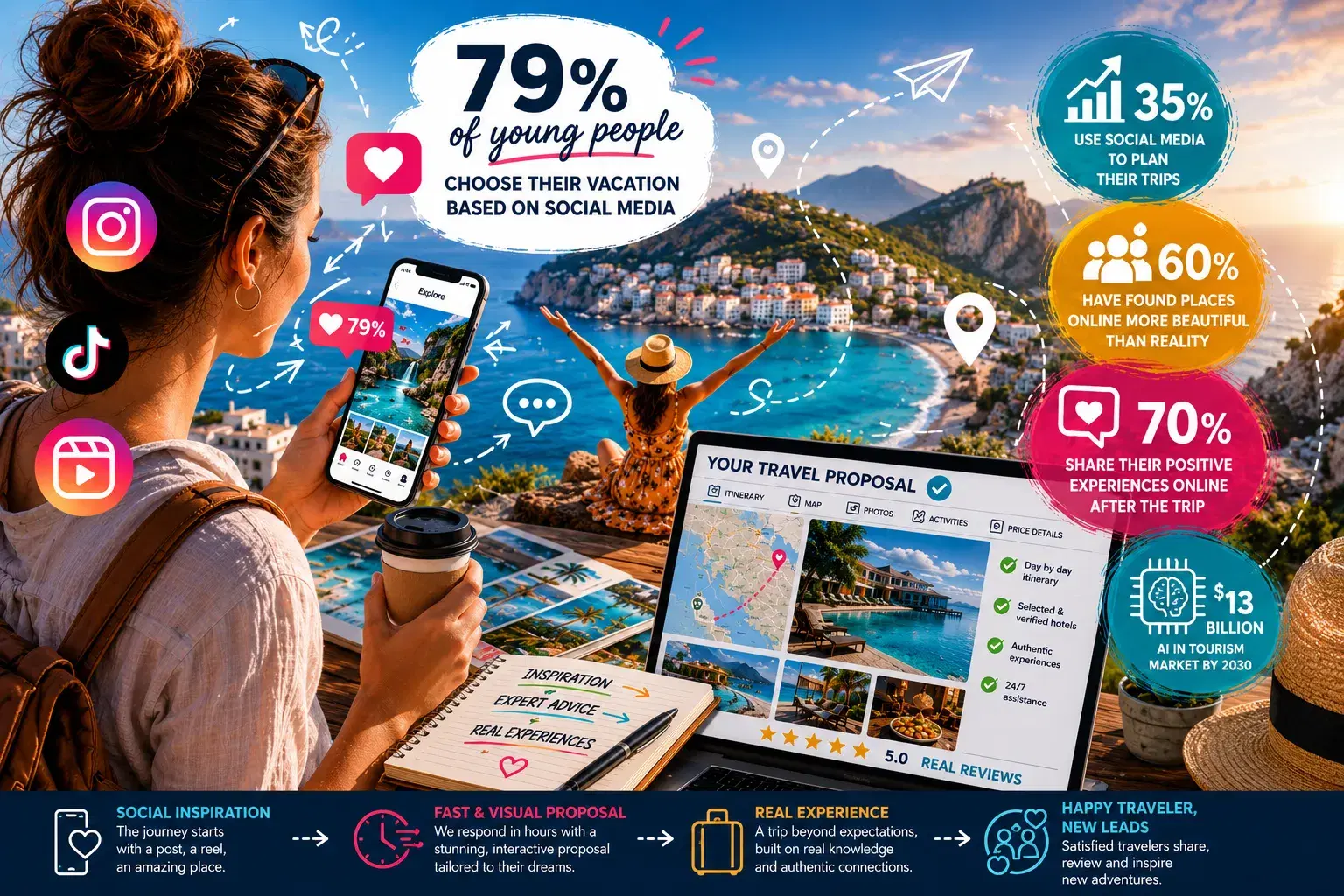
79% of Young Travellers Let Social Media Choose Their Holiday
Social algorithms now drive destination choices for Millennials and Gen Z. But 60% end up disappointed. Agencies that bridge digital inspiration with verified experiences capture the high-value demand the algorithm creates.
79% of young travellers let social media choose their holiday: how agencies can ride the trendification wave without being swept away
The modern trip doesn't start at an agency. It starts scrolling a feed. According to the latest data, 79% of Millennials and Gen Z say they let social media guide their destination and itinerary choices. 82% admit they're willing to do something completely out of the ordinary just to be able to share it online. It's no longer the trip that generates the content, it's the content that generates the trip.
For travel agencies, this scenario isn't a threat. It's a massive opportunity, provided they understand the dynamics at play and position themselves at the right point in the value chain.
Trendification: when the algorithm becomes the tour operator
The phenomenon has a precise name: trendification. Social platform algorithms make a destination go viral within weeks, influencing tourist flows, accommodation availability, and pricing. The numbers speak clearly: 35% of travellers use social media to plan their holidays, with 13% year-on-year growth. On Instagram, the word "travel" is associated with over 700 million posts. 76% of those consuming travel content say they found their inspiration to travel thanks to these platforms.
But trendification has a dark side. Destinations explode in popularity unpredictably. Properties fill up. Prices surge. And the traveller who arrives with expectations built on filtered reels and retouched photos ends up disappointed. 60% of users admit they've visited places that looked far more attractive online than in reality.
For an agency, this gap is precisely the problem to solve, and the service to sell.
From advertising to relationships: social selling in travel
Traditional advertising in travel is dead. Nobody clicks a banner saying "Maldives from £1,299" anymore. The 2026 traveller wants authenticity, interaction, content that builds trust. Social selling: building genuine relationships through social media to guide the client toward a purchase decision, has become the dominant channel.
The numbers confirm it: over 60% of people are more likely to visit a business after a positive social media interaction. 52% of tourists say they're more likely to book after seeing online content. Over 70% share their positive experiences post-trip, triggering organic visibility more powerful than paid advertising.
For the travel agency, this means every satisfied client is a marketing channel. Every successful trip is potential content. Every positive review works around the clock. But to capitalise on this dynamic, you need a system that transforms client satisfaction into a measurable asset: not a vague memory in the operator's head.
The AI travel market: $13 billion by 2030
Artificial Intelligence is massively amplifying the effectiveness of these tools. The global AI market in travel, starting from $2.95 billion in 2024, could exceed $13 billion by 2030. Chatbots for continuous assistance, dynamic pricing, personalised suggestions based on user behaviour, online conversation analysis: all of this is redefining how travellers discover, plan, and book.
For the traditional agency, AI isn't the enemy. It's the tool that enables anticipating needs, intercepting emerging trends, and adapting offerings in real time. But it requires an infrastructure shift: client data must be structured, quotes must be digital and interactive, communication must be tracked. You can't do social selling if the follow-up is a PDF via email that the client receives 4 days after the interaction.
The reputational boomerang: Instagram vs reality
The biggest risk for those operating in travel in 2026 isn't AI replacing agencies. It's the gap between promise and reality. Overexposure to aestheticised images has raised expectations to unsustainable levels. And when the client arrives to discover that the viral beach is actually a crowded patch of sand, or the "boutique" hotel has paper-thin walls, the reputational boomerang is immediate and amplified: one negative online review reaches 10 times more people than a positive one.
Here the agency has a structural advantage over OTAs and influencers. The agency knows destinations first-hand. It can distinguish between the Instagram photo and the on-the-ground reality. It can tell the client "that place is beautiful but in August it's unbearable. I'll suggest an alternative no algorithm would recommend." This is the value of human consultancy: the ability to filter algorithmic noise and deliver an authentic experience.
But this value only comes through if the agency can communicate it with the same speed and visual quality the client expects. A text-only quote without photos, without a map, without interaction (however honest and well-crafted) loses against the polished OTA proposal or the TikTok reel.
How the modern agency rides trendification
Agencies thriving in the trendification era don't fight algorithms, they use them as intelligence sources. They monitor which destinations are going viral. They prepare proposals before demand explodes. And above all, they add the layer no social media can offer: on-the-ground verification, direct relationships with local suppliers, and genuine personalisation.
The winning strategy has four pillars:
Speed of response. The socially-inspired client wants a proposal now, not next week. If the agency takes 5 days to build a quote, the client has already booked on Booking. A quote delivered in hours (with photos, map, day-by-day details) captures the client at their moment of enthusiasm.
Presentation that matches social standards. The quote must be visually competitive with the content that inspired the client. If the client has seen stunning photos on Instagram, you can't respond with a text PDF in Times New Roman. You need a portal with professional imagery, an interactive route map, evocative descriptions. The format must match the content's standard.
Verifiable authenticity. Trendification creates inflated expectations. The agency must position itself as the reality filter, "I'll tell you what's genuinely wonderful and what's merely photogenic." This builds long-term trust that no influencer can replicate. But communicating it effectively requires fluid two-way communication, not formal emails with 48-hour response times.
Capitalise on the post-trip. 70% of travellers share positive experiences online. The agency must make this sharing easy and trackable. Structured feedback (star rating plus comment, collected at the right moment) becomes a social selling asset. A 5-star rating collected automatically through the portal after the trip is worth more than any advertising campaign.
The virtuous circle: from social lead to loyal client
The dynamic is clear. The client arrives from social media with a vague idea and sky-high expectations. The agency responds with speed (proposal in hours), visual quality (portal with photos and map), and genuine expertise (advice that distinguishes the viral from the validated). The trip exceeds expectations because it was built on solid foundations, not Instagram filters. The client returns thrilled, leaves excellent feedback, shares it on social: generating the next lead.
This virtuous circle only works if the agency has the infrastructure to sustain it. A CRM that tracks where the lead came from (social, website, word of mouth). A fast quoting system with templates by destination and up-to-date rates. A client portal that competes visually with the digital experiences travellers are accustomed to. An automated feedback collection mechanism triggered at the right moment.
Without this infrastructure, the agency remains in the old world: the client arrives inspired by social, but the purchasing experience disappoints, not the trip, but the process. And in 2026, the process is an integral part of the product.
Social media won't replace the agency: it makes agencies more necessary
The "social will replace agencies" narrative is exactly as wrong as "AI will replace agencies." Social creates demand, it doesn't satisfy it. It generates inspiration: not guarantees. It shows photos: it doesn't solve problems. The 60% disappointment rate versus reality proves it: those who rely solely on social to decide often decide poorly.
The agency that positions itself as the bridge between digital inspiration and real experience occupies a space no algorithm can fill. But it must do so with 2026 tools: not 2010 ones. It must be fast like social, visual like Instagram, interactive like an app, and reliable like only a professional with first-hand experience can be.
Those who do this transform trendification from a threat into a growth engine. Those who don't, watch their clients book elsewhere, while scrolling their feed.
Ready to modernise your agency?
itinovo CRM handles margin scheme VAT, quotes, invoicing and suppliers, so you can focus on your clients.
Start free trial