
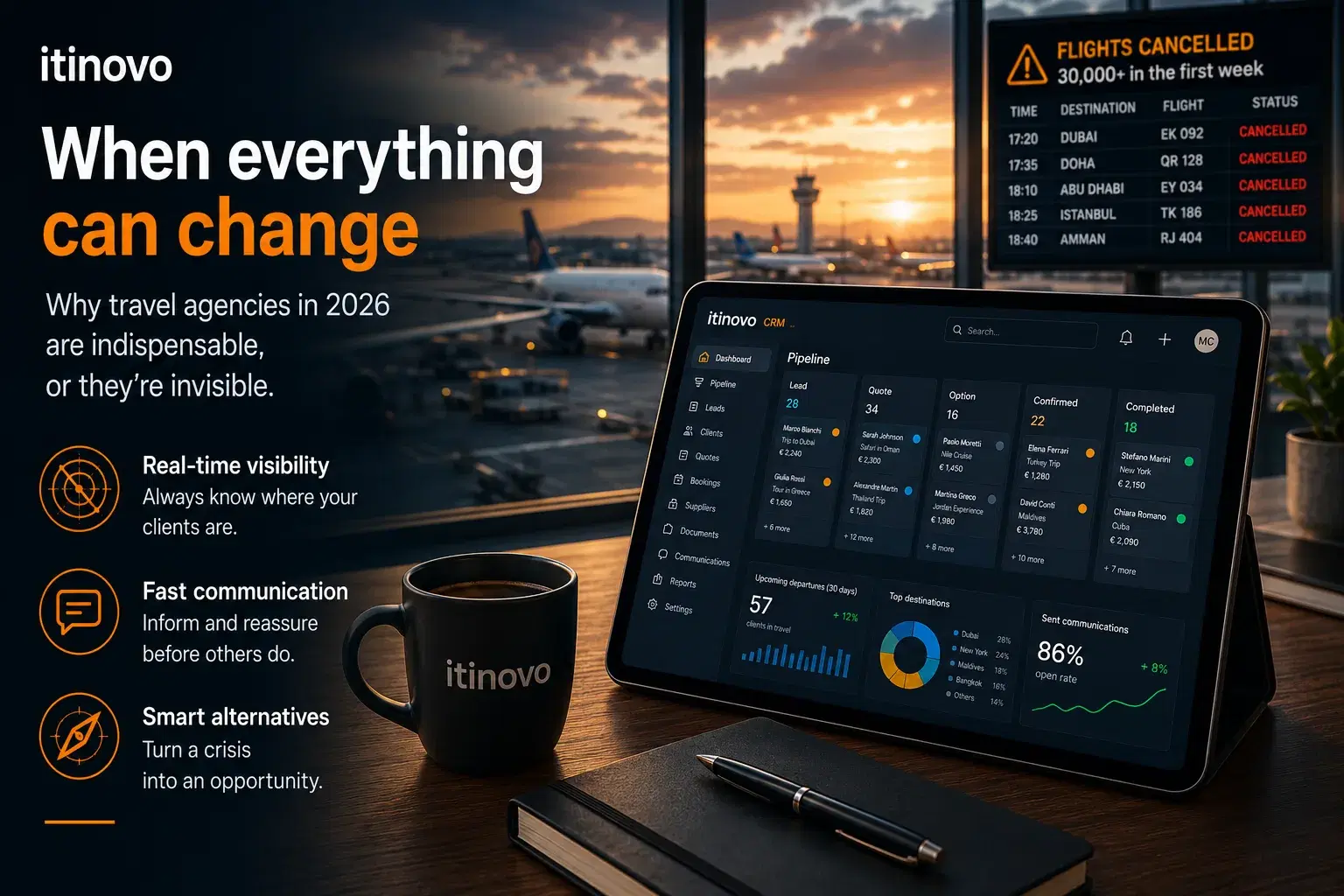
Geopolitical Crises and AI: 2026 Decides Who Survives
30,000 flights cancelled overnight, AI booking on behalf of clients. The Middle East conflict and the rise of agentic AI are reshaping the industry. Agencies that react in hours thrive. The rest disappear.
28 February 2026: the day 30,000 flights disappeared
When US military strikes on Iran closed Middle Eastern airspace, the corridor connecting Europe and Asia through Dubai, Doha and Abu Dhabi (carrying 40 million passengers annually) shut down within hours. Thirty thousand air services cancelled in the first week. Hotel occupancy in Dubai collapsed. Cruises diverted. Packages to Jordan, Egypt and Turkey cancelled en masse.
For travellers who had booked on Booking.com or Expedia, the situation was this: an automated cancellation email, a voucher, and a helpline with 45 minutes of hold time. For those who had a travel agency, the situation was different: a phone call from their consultant by mid-morning, three alternatives already prepared, rebooking completed before lunch.
This is not rhetoric. It is what happened in March 2026 at agencies that had their systems ready. And what did not happen at agencies still managing everything with emails and spreadsheets: where clients waited days, where rebookings arrived late, where some lost the client forever.
The Middle East crisis is not an isolated event. It is the new normal. And it made obvious a truth the industry had been avoiding for years: travel agencies in 2026 are either indispensable or invisible. There is no longer any space in between.
The AI paradox: it makes you obsolete and indispensable at the same time
While agencies were managing the Middle East crisis, another earthquake was moving beneath the industry's feet. Booking.com launched its "Connected Trip" with agentic AI. Expedia released agents that plan, compare and book in a single conversation. Google is integrating trip planning directly into search results.
The numbers are brutal: in 2025, 68% of travellers used some form of AI during their booking journey. The average trip that previously required 38 websites, 141 page views and over 5 hours of research now compresses into a 10-minute conversation with an AI assistant. Half of travellers in major markets have already used AI to plan a trip, and nearly 8 in 10 of those went on to book based primarily on the AI recommendation.
For simple bookings (a flight and hotel for a weekend in Barcelona) the traditional agency no longer makes sense. AI does it better, faster, at any hour. This is a fact, not an opinion.
But here is the paradox. Expedia's own 2026 report reveals an enormous "trust gap": travellers use AI to explore and plan, but when they need to spend real money (especially on complex or expensive trips) they want a brand or a person they trust. AI is excellent at structuring information and accelerating decisions, but it cannot manage emotional nuance, contextual judgment or human reassurance. Especially when things go wrong.
And in 2026, things go wrong often.
The Middle East lesson: value shows in crisis
When airspace closes, when a volcano erupts, when a country goes to war: the value of a travel agency becomes suddenly obvious. But only for agencies that are able to react.
Reacting means: knowing exactly which clients are travelling right now and where. Knowing who departs next week towards a risk zone. Having supplier contacts at hand to negotiate alternatives. Being able to communicate with 50 clients in an hour, not a week.
Agencies that in March 2026 had a CRM with an updated pipeline could filter in 30 seconds all clients with departures to the Middle East in the following 4 weeks. They sent proactive communications before clients called in panic. They proposed alternatives (Western Europe, the Mediterranean, North Africa) with quotes already prepared.
Agencies working with Excel and memory spent days reconstructing who had booked what, searching old emails, responding one by one. Some clients had meanwhile already rebooked on Booking by themselves. Lost.
Crisis does not create the agency's value. It reveals it. But only if the infrastructure is there.
The 2026 agency: crisis manager, not ticket office
The winning positioning for a travel agency in 2026 is not "I find you the cheapest flight", AI does that better than you. The winning positioning is: "when something happens, I am here and I know what to do."
This means three concrete things:
The first is real-time visibility. Knowing at every moment how many clients are travelling, where, with which suppliers, on which flights. Not out of curiosity: to be able to act within minutes when needed. An updated departure calendar, a pipeline with correct statuses, supplier contacts linked to every booking.
The second is communication speed. When 30,000 flights are cancelled, the client who receives a proactive message from the agency within 2 hours feels protected. The one who has to call and wait on hold feels abandoned. The difference between the two scenarios is often just a system that allows filtering, selecting and communicating at scale: not emails written by hand one by one.
The third is the ability to propose alternatives rapidly. A client whose Dubai trip has fallen through does not want to hear "we will think about it and call you back next week." They want three options by tomorrow. An agency that has quote templates, updated supplier rates and a system to build an alternative in 20 minutes instead of 3 hours turns a cancellation into a sale.
The numbers that matter: the cost of not being ready
Let us do the maths. An average agency with 200 active clients manages around 15-20 departures per month. In a crisis like March 2026, suppose 10% of next month's departures are towards impacted areas, that is 2 trips to rebook immediately, plus 5-6 reassurance requests from worried clients.
If the agency takes 3 hours per rebooking (finding the original booking, contacting suppliers, building the alternative, communicating with the client) that is 6 hours of urgent work. If it takes 45 minutes because everything is in a system (supplier, confirmations, contacts, templates) that is 1.5 hours. The time saving is real, but the true saving is the client you do not lose.
A client lost through poor crisis management does not return. And they talk. The reputational cost of a badly managed rebooking is incalculable, in an industry where word of mouth is worth more than any advertising campaign.
Conversely, a well-rebooked client becomes an evangelist. "My agency called me before I even saw the news on television" is the phrase that generates referrals. It is marketing you cannot buy.
Agentic AI is not the enemy: it is the filter
Let us return to AI. The dominant narrative is "AI will replace travel agencies." The reality is more nuanced and, in some ways, more favourable to agencies than it appears.
Agentic AI is indeed eliminating the need for intermediaries on simple, transactional bookings. City break in Europe, flight plus hotel, no complications. For this type of trip, the agency was already struggling for years against OTAs, AI simply accelerates an existing trend.
But AI is also creating a new type of demand. Travellers who use ChatGPT or Booking's assistant to plan quickly discover the limits: AI suggests but does not guarantee. It has no supplier relationships. It cannot negotiate an upgrade. It does not answer the phone at 11pm when the flight is cancelled. It does not know that small family-run hotel in Puglia that is not on any platform.
The result is market polarisation. On one side, simple trips migrate entirely to AI and platforms. On the other, complex, expensive or high-risk trips: families with young children, honeymoons, groups, unstable destinations, multi-country itineraries, become even more "agency territory" than before. Because the traveller who has tried AI knows exactly what AI cannot do.
The filter works like this: AI takes the clients you would not have kept anyway (the EUR 200 weekend ones) and leaves you those who genuinely need you (the EUR 5,000 trip with 4 stops). Your job is to be ready for the latter.
What you concretely need: the survival checklist
No revolutions needed. Just solid foundations. Here is what distinguishes a ready agency from a vulnerable one in 2026:
A system where every lead, every quote, every supplier confirmation is tracked and retrievable in seconds. Not in an email folder, not in a shared spreadsheet, in a place where you can filter "all clients departing to the Gulf in the next 6 weeks" and have the answer instantly.
A quoting workflow that lets you build an alternative in minutes, not hours. Templates by destination, updated supplier rates, automatic margin calculation. When the client calls because Dubai has fallen through, you already have Crete, Sardinia and Morocco ready with the numbers adding up.
Tracked communication with clients. Knowing who you contacted, when, what you proposed, whether they responded. Not for bureaucracy, so you do not forget anyone when managing 20 rebookings simultaneously.
Centralised supplier confirmations. When you need to cancel 5 hotel bookings and 3 transfers, knowing exactly the status of every confirmation, the supplier contact and the cancellation conditions: without opening 15 different emails.
None of this is science fiction. It is organisation. But organisation, in 2026, is the difference between an agency that thrives and one that closes.
The moment is now
The Middle East conflict has shifted millions of bookings towards Western Europe. Barclays confirms it: demand is not falling, it is redirecting. Travellers who had planned Dubai or Jordan are looking for alternatives in the Mediterranean, Greece, Spain, Italy.
For European agencies, this is a concrete and immediate opportunity. But only for those that can intercept this demand, propose rapidly, and handle the volume without drowning.
Simultaneously, AI is educating a generation of travellers to expect immediate responses, personalised quotes and constant communication. The client who uses ChatGPT to plan expects the same level of reactivity from their agency. If they do not find it, they go back to AI.
The window for positioning is narrow. Agencies that today invest in tools, processes and speed will be those that clients choose when (not if) the next crisis arrives. And in the meantime, they will also be those that convert better day-to-day, because an organised system does not only serve in emergencies. It serves every day, for every quote, for every client.
2026 is not the year travel agencies die. It is the year that decides who survives.
Ready to modernise your agency?
itinovo CRM handles margin scheme VAT, quotes, invoicing and suppliers, so you can focus on your clients.
Start free trial